Weekend in Omaha – Berkshire and Markel meetings

Spent the weekend in Omaha after 12 long years. It was a weekend worth its time. It’s a place to reflect and see the vision of some of the leaders who share openly and give more than they need to . These are not comprehensive notes but some key notes from the different meetings.

Tom Gayner has some interesting nuggets to add during the Markel Brunch:

  1. On Cyber Insurance: The limits are small and understands the aggregation risks well. Ajit Jain in Berkshire is worried about writing large risks like cloud cyber security where as Markel specializes with much smaller limits and understands aggregation well. Markel is in a different space on cyber insurance compared to Berkshire.
  2. On Berkshire selling Markel: Learnt about in 13F when it was bought. Thought it was a housekeeping seal of approval. Learnt about it on 13F when it was sold. Does not have any insights on Berkshire’s actions but is buying Markel with his own capital because he thinks its undervalued. Re-iterated a couple of times that Markel is trading much lower than his estimate of intrinsic value. Was pretty open about it.
  3. Direct question on EBITDA as bullshit earnings: Charlie says what Charlie says. Gave an example of how book value of Coca Cola is $6/share where market price is $60/share. When you buy BRK at 1.5BV, you are essentially buying at $90/share and when you buy MKL that owns BRK at 1.3 or 1.4 times earnings, the value is essentially different as well. The key is to be able to bridge it to cash earnings at the end of the day. Made me think quite a bit about owning Markel and what AAPL earnings yield was on that (through the Berkshire holding) given that AAPL itself is close to 3% annualized earnings yield.
  4. Combined Ratio: is important but need to see it in combination with how many years have the reserves and estimates of losses been below the estimates. Markel (and Berkshire) are very conservative and have great records.
  5. The combined ratio discussions got me personally thinking about in this more higher interest rate environment, where the borrowing cost for the US govt is 4-5 pts, we have a business model (both Markel and Berkshire) which earns around 2-4 pts on combined ratio and can borrow at 700-800 bps of spread to the US govt. Even if the portfolio generates the same returns as the S&P 500, the risk levels must be meaningfully lower.
  6. Vision for Markel: Spent a bit of time talking capital allocation and the vision for Markel with the three engines on Insurance, portfolio and ventures. I think Gayner is set on accelerating the ventures a lot more aggressively and really go after the mini-Berkshire model. We might finally see his stamp in transforming this from a stodgy conservative insurer to a mini-Berkshire. Noted that they would probably not be doing acquisitions that will double their size or so.

Ajit Jain: Was sharp as a tack and came across as very direct, blunt and razor sharp in his thinking.

  1. Succession: Warren reiterated there cannot be another Ajit. Ajit claims he is building leaders to succeed him when the time comes.
  2. Cyber insurance: Spoke about the aggregation of risks and issues with writing large deals on cyber insurance like cloud cyber attacks and issues with estimating the losses on them. Reiterated that Berkshire considers that money is lost every time a cyber policy is written.
  3. Climate Change: All policies are priced yearly. Climate change like inflation will be the friend of the risk bearer provided its priced appropriately.
  4. Geico: This was probably the most disappointing piece of Ajit’s comments. Reiterated that Geico is still behind, building up infrastructure and will have systems and infra ready by 2025. Warren noted Geico is still the lowest cost player and there is no risk of failing or even losing profitability. It felt as though the entire discussion was defensive in nature. In contrast, Geico in the past has always been heralded as a wonderful company where the moat was widening; the comments made it clear that the moat is shrinking and the management at best has a strategy to catch up.

Greg Abel: Was composed, solid as a rock. Created the right impression that he was the right next leader for Berkshire.

  1. Management: Leaders are talking to him and more engagement with the operating managers on running the business.
  2. Pacific Power: reiterated along with Warren that they will not throw good money after that. Separated out good regulatory states like Utah versus Oregon and California. Utah caps economic claims. Oregon lawsuits and claims are adding up but does not think they have much merit. Regulatory reform much chance in the western states.
  3. BNSF: acknowledged that BNSF had the worst operating ratio of the 5 class 1 carriers. Sounded a lot like the Geico discussion. Felt like the moat was shrinking rather than increasing for the business. There could be two tacts to this: a. Underpromise and overdeliver b. Or the business is indeed losing its widening moat position. Only time will tell.

Tracy Britt Cool: Kanbrick capital. More hands on approach to management and create opportunities in mid size companies using private capital. 5 years as investor in Berkshire, 5 years as operator and now in Kanbrick. Talked about being an investor, operator made her a better capital allocator.

  1. Pampered Chef: In Berkshire, she served as CEO of Pampered Chef. The business had run down from $700M to $300M in the decade before she stepped in. Made me wonder quite a bit about the decentralized model of Berkshire and how problems remain undetected for so long making tough turnarounds even tougher. Even though Todd Combs is at Geico and BNSF is being worked over, made me think of parallels whether the decentralized ownership led to some for the shrinking of the moats in the two pillars of Berkshire.
  2. Private Equity: Kanbrick runs as a private equity. It was not clear how the capital structure ensured long term capital because the key pitch was that they invested in things that take time that normal public companies could not or would not have the patience to invest in.
  3. Kanbrick business system: Has a business system similar to Danahear around Systems, people, operating models and KPIs to enable mid size companies to operate and standardize. Works for most companies except some companies that relied on creative talents.

Warren Buffett: Lots of repeat comments from prior meetings. Few evasive answers. Some average questions from the crowd but Becky’s questions were good. A couple of aww shucks moments when he looked around for Charlie and ended the meeting hoping that he would come back next year.

  1. Apple Sales: More of them coming? Warren hinted that they would end at $200B at end of Q2 2024. They had $181B at end of Q1. $8-9B from operating earnings leaves them around $10B of potential AAPL sales. A possibility for sure given his comments on APPL.
  2. Paramount: Owned up that neither Todd or Ted had anything to do with it. Then he made one of those profound statements that Warren makes (remember how he referred to iPhone as the single most important piece of real estate for every human being that the individual treasured) and said it made him think about how people spent their leisure time and how that has changed over time.
  3. AI: Every reference to AI had a reference to Nuclear weapons. Clear that he sees the risks a lot more deeply than the general population does. Talked about deep fake AI video of him saying things he never uttered. Called scamming a growth industry.

Charlie was missed. Warren Buffett is walking around with a cane. Ajit Jain’s shaking on his hands that I had noticed before was not visible this time around. Tom Garner seems very upbeat about Markel’s prospects.
Markel 2020 Shareholder letter

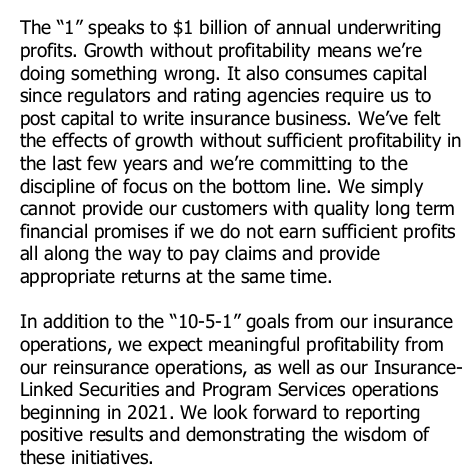
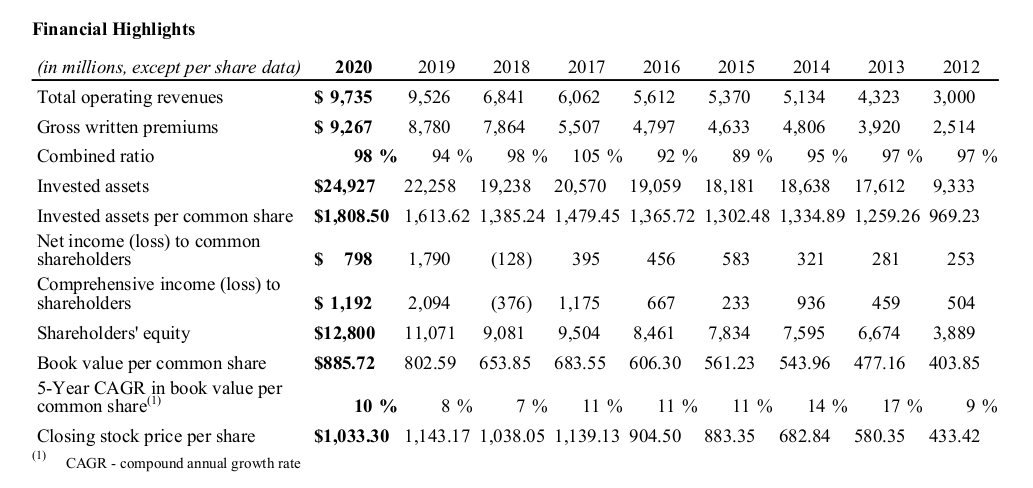
Reading through the 2020 letters to the SH, $MKL BVPS has compounded close to 10% but stock price has compounded only 3% due to a higher starting p/b and multiple compression.

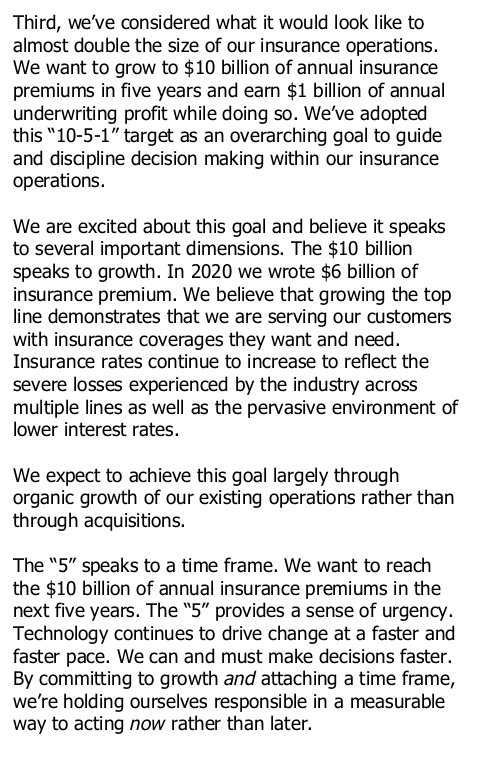
$MKL — this paragraph below should cause some serious concerns with investors. the insurance business have never done well when they have chased growth before. The underwriting profits or losses always show up years later. Putting a goal on premiums is risky….

$MKL – even though there is a implied combined ratio in the goal. In this industry, it never bodes well to write policies more aggressively especially when one does not know whether it will be a hard or a soft insurance market.

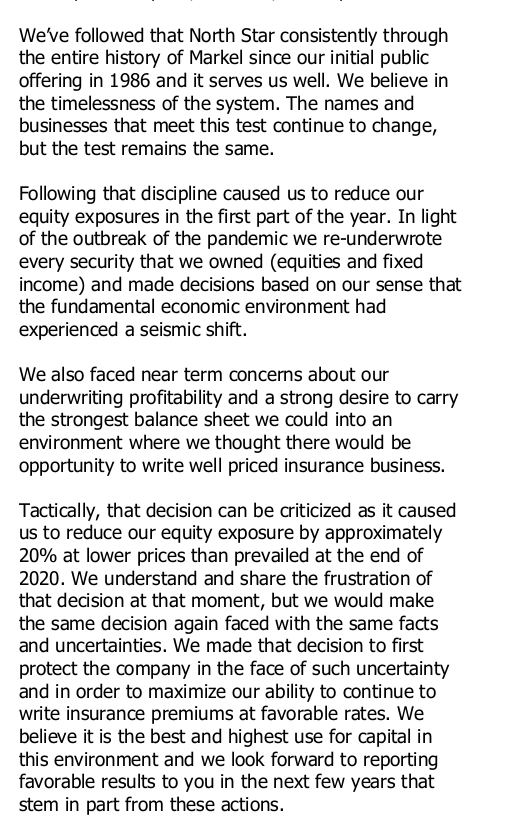
$MKL — with the amount of fixed income that they have to cover for all the insurance losses, one would have hoped that the management would not have had to sell equities during the first half of 2020. Looks like the equity exposure reduced by close to 20%. A significant drag…

$MKL — while Gayner has been rock solid in his investments and it is clear that investing in H1 2020 would have been great only in hindsight, it is also imperative that we call out the reduction in equity exposure during the lows on such a so called conservative balance sheet.

especially since they had raised close to $600M on preferred equity as well in Q2 2020.

Originally tweeted by Beowulf (@beowulfcapital) on May 9, 2021.

Markel Q1 2021

Markel Thread (1/X)

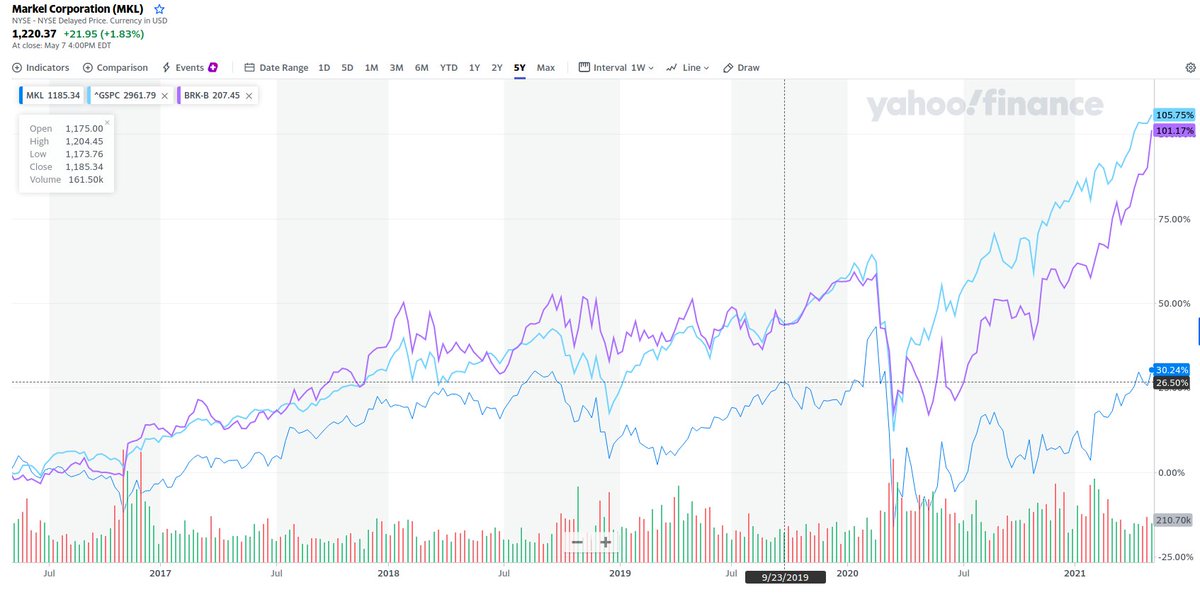
Markel has severely under performed the S&P 500 & $BRK in the last 5 years…

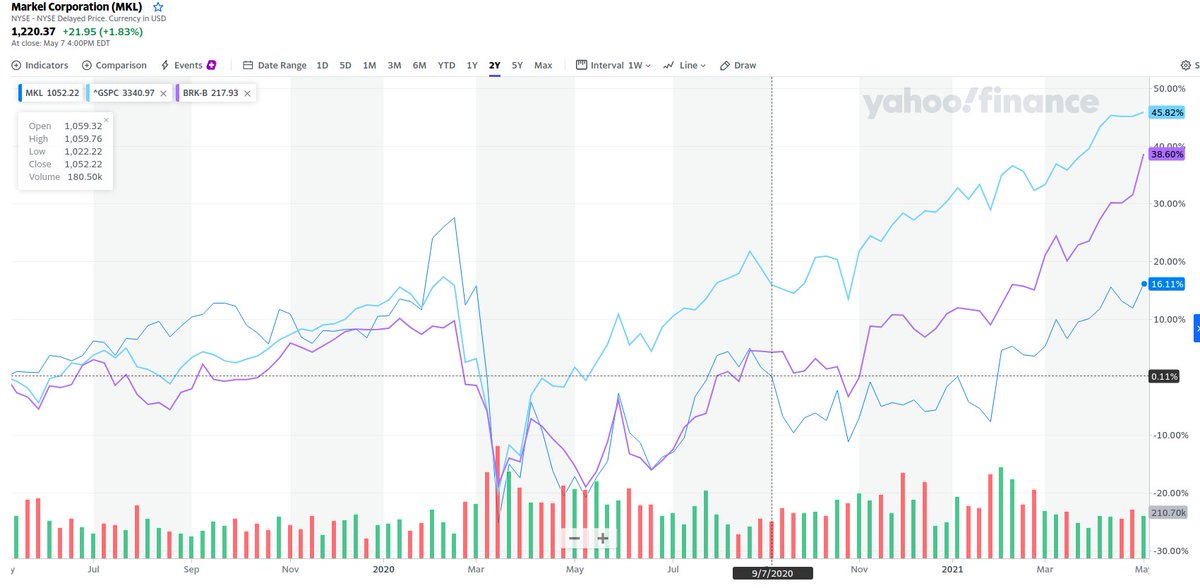
2 year and 1 year….

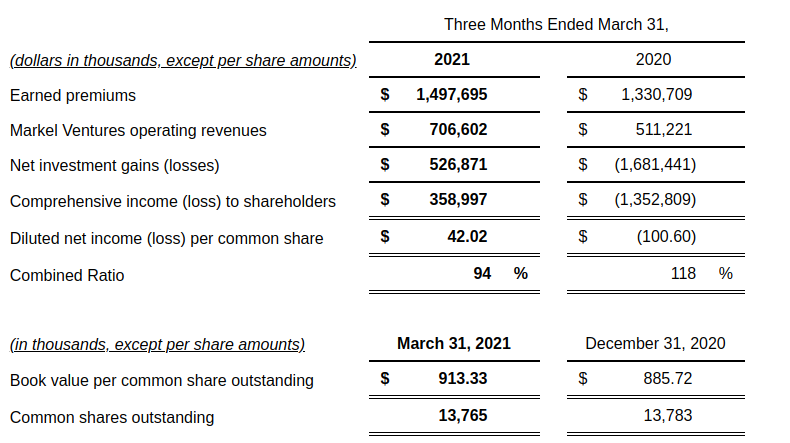
$MKL recently announced their Q1 2021 results. They ended Q1 2021 with BVPS of $913 implying a P/B of 1.33 which is still pretty sporty for $MKL. the good news was that the combined ratio was pretty healthy at 94% and Markel Ventures continues to grow robustly

$MKL has a total SOS of 13.75M which has largely remained the same over the last several years. Continue to hold a significant fixed income portfolio of $787/share & equities portfolio of $547/share. ST investments $198/share and unrestricted cash $282/share

Unpaid losses and unearned premiums which are the main drivers for float are close to $1559/share or close to $21B. Largely unchanged from last year. Net investments gains for the quarter was $526M translating to $38/share

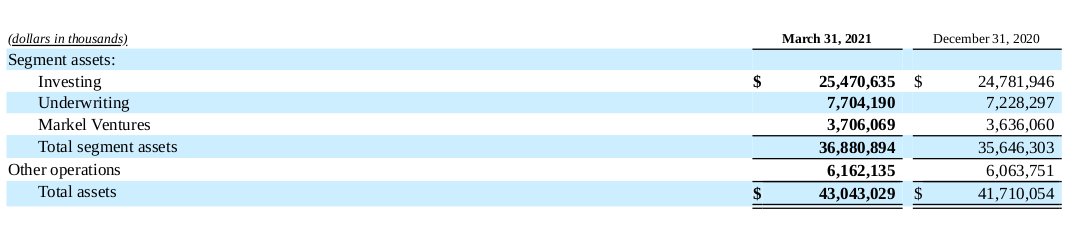
Out of the $43B assets on the balance sheet, $25B are in investments, $7B supporting the insurance operations and $3.7B on Markel Ventures. The ventures portion is still a pretty small portion of the assets from $MKL (a far cry from $BRK.B on that regard)

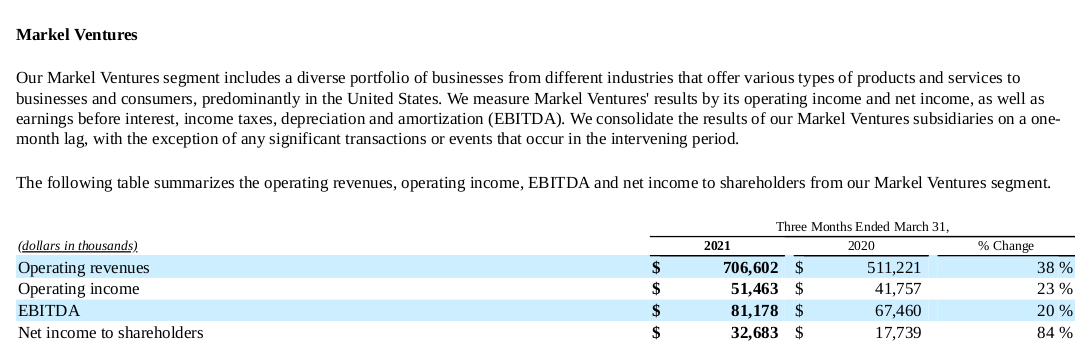
Markel Ventures net income and EBITDA continues to improve but at a rate lower than revenue growth… The ROA continues to pretty low at this point even from a EBITDA perspective.

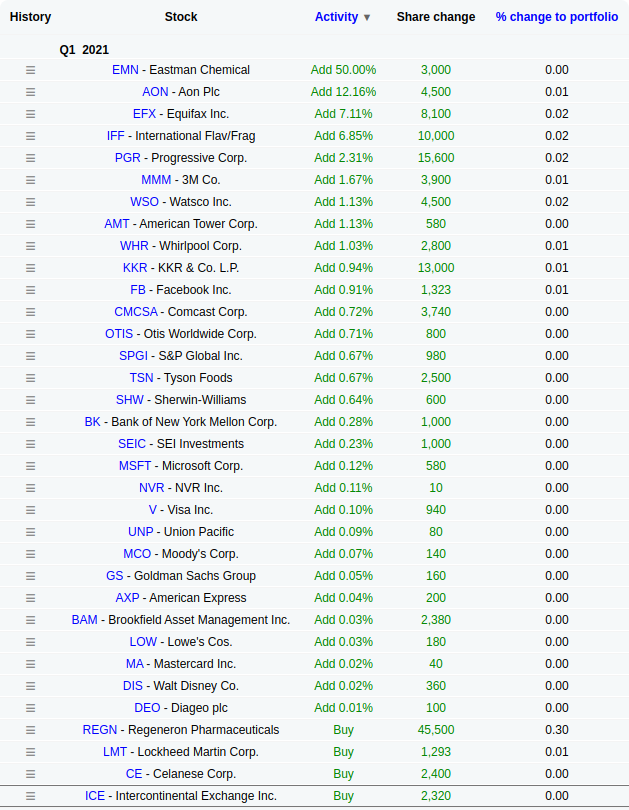
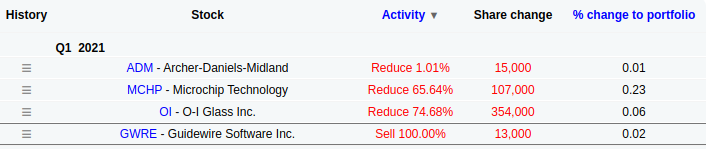
Fairly modest buying on equities in Q1 2021 along with fairly thin selling as well. All in all, Gayner is sitting tight. (datasource: Dataroma)

All in all, a solid quarter. No significant changes in the equity portfolio. The valuation is too extremely high but is not too low either. The points in history where it was available close to book value is far and few in between. Ventures is making progress but still a drag!

Originally tweeted by Beowulf (@beowulfcapital) on May 9, 2021.

Markel Corp. equity portfolio

Reposting with edits as the prior post is not updating online.

Markel (MKL) closed at $785/share as of March 20th. Since the reported book value of MKL was $802 as of Dec 31st, I wanted to look into the equity portfolio of $MKL and see the effect on its book value. At the closing price of $1,143 on Dec 31st, MKL traded at a P/B of 1.42.

Given the carnage in the market, the equity value of its U.S listed stocks are down from $7.2B to $4.95B (see below) which is 31% below 12/2019. Of course, there is a possibility that Markel could have sold stocks before the meltdown or could have increased the equity holdings materially but neither will be known at least until early May.

With 13.7M shares outstanding as of 31/12, the book value change just from marking the equity book to market would be $162/share. Adjusting for this, the book value for Markel would be ~$640/share. Markel also has deferred taxes of $996M related to investments. This translates to $72/share. At the corporate tax rate of 21.2% (2019 rate) Markel can offset about $34/share of the equity price decline resulting in a book value of $674/share. The new price/book will be 1.16. This is definitely more cheaper than 31/12.

At this point, it is also not clear whether the insurance operation will take any hit due to any exposure to Covid as well. While Markel does trade much cheaper than it has for a long time, it is far from trading below book value like it did very briefly when the acquisition of Alterra was announced.

Disclosure: Long Markel.

Thanks for @rationalwalk for pointing out the deferred taxes.

Stock Value as of 31/12 Price on March 20th Portfolio Value
KMX – CarMax Inc. $430,729,000 $44.27 $217,501,608.90
BRK.A – Berkshire Hathaway CL A $375,247,000 $257,346.00 $284,367,330.00
BRK.B – Berkshire Hathaway CL B $345,720,000 $170.06 $259,572,271.42
BAM – Brookfield Asset Management Inc. $334,930,000 $38.65 $223,962,874.65
DIS – Walt Disney Co. $268,206,000 $85.98 $159,443,891.40
MAR – Marriott Int’l. $240,057,000 $74.58 $118,229,362.02
DEO – Diageo plc $227,333,000 $109.56 $147,884,088.00
HD – Home Depot $200,909,000 $152.15 $139,978,000.00
GOOG – Alphabet Inc. CL C $181,244,000 $1,072.32 $145,361,554.56
AMZN – Amazon Corp. $180,963,000 $1,846.09 $180,791,285.88
V – Visa Inc. $179,472,000 $146.83 $140,244,674.50
UNH – United Health Group Inc. $176,094,000 $206.59 $123,747,410.00
DE – Deere & Co. $174,282,000 $111.63 $112,288,617.00
WBA – Walgreens Boots Alliance $121,310,000 $46.42 $95,509,150.00
BLK – BlackRock Inc. $110,594,000 $354.72 $78,038,400.00
RLI – RLI Corp. $107,779,000 $73.63 $88,155,137.36
ADI – Analog Devices $101,705,000 $85.08 $72,812,399.88
TXN – Texas Instruments $91,663,000 $97.60 $69,735,200.00
ADP – Automatic Data Processing Inc. $90,484,000 $112.06 $59,470,242.00
JNJ – Johnson & Johnson $89,097,000 $119.89 $73,228,812.00
AAPL – Apple Inc. $88,105,000 $229.24 $68,780,023.40
UL – Unilever PLC $87,333,000 $47.17 $72,056,892.00
GS – Goldman Sachs Group $78,613,000 $138.41 $47,322,379.00
MSFT – Microsoft Corp. $74,847,000 $137.35 $65,189,057.00
LOW – Lowe’s Cos. $69,580,000 $66.36 $38,555,160.00
WSO – Watsco Inc. $69,808,000 $145.71 $56,462,625.00
BX – The Blackstone Group $68,415,000 $37.67 $46,070,410.00
GD – General Dynamics $68,247,000 $113.99 $44,114,130.00
ADM – Archer-Daniels-Midland $67,824,000 $30.61 $44,791,613.00
ANTM – Anthem Inc. $67,655,000 $191.59 $42,916,160.00
MMC – Marsh & McLennan $67,905,000 $79.87 $48,680,765.00
NVO – Novo Nordisk A S $62,221,000 $49.46 $53,169,500.00
MA – Mastercard Inc. $61,465,000 $211.42 $43,520,807.00
AXP – American Express $59,911,000 $74.12 $35,670,250.00
ECL – Ecolab Inc. $59,113,000 $141.88 $43,457,844.00
ITW – Illinois Tool Works $57,302,000 $125.78 $40,123,820.00
BF.A – BROWN FORMAN Inc. A $52,916,000 $45.94 $38,727,420.00
SCHW – Charles Schwab $51,493,000 $30.75 $33,293,025.00
MCO – Moody’s Corp. $49,804,000 $175.80 $36,879,324.00
APO – Apollo Global Management $48,306,000 $26.84 $27,175,500.00
PGR – Progressive Corp. $46,329,000 $68.28 $43,699,200.00
SBUX – Starbucks Corp. $45,689,000 $58.03 $30,156,334.04
NSC – Norfolk Southern Corp. $44,552,000 $123.71 $28,391,445.00
SMG – Scotts Miracle-Gro Co. $44,808,000 $83.53 $35,249,660.00
TRV – Travelers Companies Inc. $43,139,000 $89.51 $28,195,650.00
CAT – Caterpillar Inc. $41,941,000 $95.50 $27,122,000.00
CFX – Colfax Corp. $41,294,000 $16.40 $18,615,148.00
MMM – 3M Co. $40,312,000 $124.89 $28,537,365.00
SPGI – S&P Global Inc. $40,138,000 $208.79 $30,692,130.00
KKR – KKR & Co. L.P. $39,838,000 $19.07 $26,043,899.00
CG – Carlyle Group $38,817,000 $19.39 $23,461,900.00
WHR – Whirlpool Corp. $38,733,000 $74.45 $19,546,028.55
HAS – Hasbro Inc. $38,442,000 $46.10 $16,780,400.00
TROW – T. Rowe Price Group $38,258,000 $90.34 $28,366,760.00
NKE – NIKE Inc. $37,079,000 $67.45 $24,686,700.00
SRCL – Stericycle Inc. $36,244,000 $44.68 $25,378,240.00
MHK – Mohawk Industries $35,595,000 $58.66 $15,310,260.00
MSCI – MSCI Inc. $35,370,000 $243.07 $33,300,590.00
LYV – Live Nation Inc. $34,927,000 $33.97 $16,601,139.00
ACN – Accenture $33,565,000 $149.94 $23,900,436.00
ITIC – Investors Title Co. $33,957,000 $110.90 $23,654,970.00
UTX – United Technologies $33,546,000 $82.53 $18,486,720.00
BF.B – Brown-Forman Corp. $32,055,000 $48.85 $23,164,034.95
TSN – Tyson Foods $32,365,000 $53.62 $19,061,910.00
NVR – NVR Inc. $31,819,000 $2,326.89 $19,441,165.95
BA – Boeing Co. $30,752,000 $95.01 $8,968,944.00
FDS – FactSet Research Systems $31,273,000 $217.98 $25,407,748.80
HEI – HEICO Corp. $30,588,000 $70.20 $23,983,408.80
JPM – JPMorgan Chase & Co. $30,066,000 $83.50 $18,009,280.00
FB – Facebook Inc. $29,390,000 $149.83 $21,454,157.70
ROK – Rockwell Automation Inc. $28,394,000 $126.89 $17,777,289.00
ROL – Rollins Inc. $27,169,000 $35.00 $28,677,250.00
LUV – Southwest Airlines $26,478,000 $31.94 $15,666,570.00
LBRDA – Liberty Broadband Corp. CL A $25,566,000 $87.38 $17,934,745.00
LSXMK – Liberty SiriusXM Series C $25,129,000 $25.48 $13,300,560.00
SEIC – SEI Investments $25,092,000 $38.56 $14,776,192.00
CVS – CVS Health Corp. $24,665,000 $54.70 $18,160,400.00
DAL – Delta Air Lines Inc. $24,386,000 $21.35 $8,902,950.00
PH – Parker-Hannifin $24,411,000 $102.43 $12,148,198.00
CMCSA – Comcast Corp. $23,429,000 $33.37 $17,385,770.00
LBRDK – Liberty Broadband Corp. CL C $21,643,000 $90.67 $15,605,485.71
CHH – Choice Hotels Int. Inc. $20,996,000 $57.67 $11,707,010.00
LSXMA – Liberty Sirius XM Series A $20,593,000 $25.33 $10,790,580.00
LNAGF – Linde AG $20,098,000 $151.30 $14,282,720.00
PEP – PepsiCo Inc. $19,899,000 $103.93 $15,132,208.00
SHW – Sherwin-Williams $18,090,000 $412.70 $12,793,700.00
ATVI – Activision Blizzard Inc. $16,685,000 $52.05 $14,615,640.00
CSCO – Cisco Systems $16,402,000 $35.60 $12,175,200.00
GOOGL – Alphabet Inc. $16,742,000 $1,068.21 $13,352,625.00
MCHP – Microchip Technology $16,651,000 $59.64 $9,482,760.00
MXIM – Maxim Integrated Products $15,501,000 $44.12 $11,118,240.00
EFX – Equifax Inc. $15,063,000 $105.65 $11,357,375.00
UNP – Union Pacific $15,434,000 $117.84 $10,060,000.80
HCSG – Healthcare Services Group $13,947,000 $21.58 $12,376,130.00
HXL – Hexcel Corp. $13,489,000 $32.01 $5,889,840.00
IFF – International Flav/Frag $13,676,000 $102.41 $10,855,460.00
BK – Bank of New York Mellon Corp. $12,784,000 $29.07 $7,383,780.00
EA – Electronic Arts $13,159,000 $86.94 $10,641,456.00
PAYX – Paychex Inc. $12,759,000 $51.97 $7,795,500.00
FWONK – Liberty Media Corp Formula One Series C $11,929,000 $23.00 $5,968,500.00
COST – Costco Co. $11,507,000 $290.42 $11,369,943.00
DLTR – Dollar Tree Inc. $11,578,000 $75.97 $9,351,907.00
AMT – American Tower Corp. $11,078,000 $195.39 $9,417,798.00
VRSK – Verisk Analytics Inc. $11,051,000 $124.25 $9,194,500.00
FWONA – Liberty Media Corp Formula One Series A $10,048,000 $20.85 $4,785,075.00
PM – Philip Morris Intl. $9,743,000 $61.09 $6,994,805.00
CDK – CDK Global Inc. $9,673,000 $30.98 $5,480,269.06
WFC – Wells Fargo $9,415,000 $26.50 $4,637,500.00
MCK – McKesson Corp. $8,728,000 $124.97 $7,885,607.00
AON – Aon Corp. $7,707,000 $149.55 $5,533,350.00
CABO – Cable ONE Inc. $7,740,000 $1,270.76 $6,607,952.00
CCK – Crown Holdings $8,124,000 $46.96 $5,259,520.00
TRU – TransUnion $7,448,000 $54.98 $4,783,260.00
ALB – Albemarle Corp. $5,332,000 $53.43 $3,900,390.00
LBTYA – Liberty Global Inc. $4,070,000 $17.63 $3,155,770.00
OI – O-I Glass Inc. $4,175,000 $5.67 $1,984,500.00
TRUP – Trupanion Inc. $4,120,000 $23.84 $2,622,400.00
DISCA – Discovery Communications Inc. $3,567,000 $18.76 $2,194,920.00
GHC – Graham Holdings Co. $3,323,000 $317.12 $1,649,024.00
PAG – Penske Automotive Group $3,615,000 $22.09 $1,590,480.00
Y – Alleghany Corp. $3,461,000 $467.71 $2,024,248.88
BLL – Ball Corp. $2,716,000 $54.89 $2,305,380.00
AN – AutoNation Inc. $2,120,000 $26.50 $1,155,665.00
KHC – Kraft Heinz Co. $2,185,000 $22.28 $1,515,040.00
WRB – W.R. Berkley Corp. $1,866,000 $47.58 $1,284,660.00
C – Citigroup Inc. $1,623,000 $38.06 $773,379.20
DHI – D.R. Horton $1,654,000 $31.38 $983,668.86
SHAK – Shake Shack Inc. $1,799,000 $34.78 $1,050,356.00
BKNG – Booking Holdings Inc. $411,000 $1,177.43 $235,486.00
BUD – Anheuser-Busch InBev $1,067,000 $40.30 $523,900.00
LEN.B – Lennar Corp. CL B $1,075,000 $25.28 $607,984.00
IAC – IAC/InterActive Corp. $286,000 $130.75 $150,362.50
ILMN – Illumina Inc. $332,000 $242.00 $242,000.00
LEN – Lennar Corp. $329,000 $34.08 $201,072.00
Grand Total $7,202,787,000 $4,952,512,945.77

Liberty Media — Q4 2015 Shareholding

As I continued to dig into Libery Media (LMCA/K) ownership, I came across a few interesting names that are invested along with John Malone. While it is true that LMCA/K have declined quite a bit since 12/31, we will  only know who else added in Q1 only by April 15th. I knew that Berkshire Hathaway was invested with LMCA/K but I was frankly amazed that it was close to $900M as of 12/31. Looks like one of Warren’s deputies Todd or Ted or both are dabbling with Malone’s entities. You can find our previous thoughts on Liberty Media Corporation here

Datasource: Dataroma.com

LMCA Portfolio Manager % of portfolio Shares Value as on 12/31/2015
Markel Corp 0.5 426,000 $                         16,720,500.00
Berkshire Hathaway 0.23 7,800,000 $                       306,150,000.00
 
% of portfolio Shares Value as on 12/31/2015
LMCK Weitz Value 5.75 1,150,000 $                         43,792,000.00
Century Management Advisors 2.35 39,650 $                           1,509,872.00
Markel Corp 0.54 522,000 $                         19,877,760.00
Berkshire Hathaway 0.44 15,386,257 $                       585,908,666.56

What are we reading?

Markel Q2 Results Discussion (RationalWalk)

Notes from the AGM — Bajaj Auto Ltd (Ankur Jain)

Cost of capital — Opportunity cost (Hurricane Capital)

Old Post — Alice Schroeder on Reddit (Reddit)

Buffett on Banks (Fundoo Professor)

What Geico’s acquisition costs and other associated costs taught me about business economics, management quality and valuation (Fundoo Professor)

Greenlight Re and Third Point Re

We had written about the structural advantages of re-insurers before here. We ran through some numbers and here is what we found.

Both Greenlight Re and Third Point Re are structured similarly with Greenlight Capital and Third Point LLC running the investment books. Both follow 2% management fee and 20% incentive agreements with high watermark. Currently unearned premium is around 50% of equity (actually close to 40% of equity) for both the insurers. We have assumed cost of float as 2% for both the insurers. We tried to model the returns to the shareholders under various circumstances of underlying returns from the hedge funds. The shareholder equity varying as a function of float net of the cost of float.

Underlying Equity  $100.00
Float Leverage  $ 50.00
Total Assets  $150.00 102%
Underlying Rates of Return $150 Invested After 2% Management Fee After 20% Performance Net Underlying Returns to Investor Cost of Float Net Underlying Returns of Shareholder Equity
-30% $105.00 $102.90 $102.90 -31.4% 1.0% -48.1%
-20% $120.00 $117.60 $117.60 -21.6% 1.0% -33.4%
-10% $135.00 $132.30 $132.30 -11.8% 1.0% -18.7%
0% $150.00 $147.00 $147.00 -2.0% 1.0% -4.0%
5% $157.50 $154.35 $153.48 2.3% 1.0% 2.5%
10% $165.00 $161.70 $159.36 6.2% 1.0% 8.4%
20% $180.00 $176.40 $171.12 14.1% 1.0% 20.1%
30% $195.00 $191.10 $182.88 21.9% 1.0% 31.9%

Over a period of time, if one assumes that the insurers grow their float to get a structure where they have $100 of float for $100 of equity (which is still conservative as reinsurers typically write 5X of capital) However, given the general risky nature of where the float is invested, 1X is a more proper allocation for this strategy.

Underlying Equity $100.00
Float Leverage $100.00
Total Assets $200.00 102%
Underlying Rates of Return $200 Invested After 2% Management Fee After 20% Performance Net Underlying Returns to Investor Cost of Float Net Underlying Returns of Shareholder Equity
-30% $140.00 $137.20 $137.20 -31.4% 2.0% -64.8%
-20% $160.00 $156.80 $156.80 -21.6% 2.0% -45.2%
-10% $180.00 $176.40 $176.40 -11.8% 2.0% -25.6%
0% $200.00 $196.00 $196.00 -2.0% 2.0% -6.0%
5% $210.00 $205.80 $204.64 2.3% 2.0% 2.6%
10% $220.00 $215.60 $212.48 6.2% 2.0% 10.5%
20% $240.00 $235.20 $228.16 14.1% 2.0% 26.2%
30% $260.00 $254.80 $243.84 21.9% 2.0% 41.8%

One thing is very evident here, if the re-insurers are not prudent and conservative, it will wipe out equity fast as float functions exactly how leverage does. Companies like Berkshire own whole companies where earnings are less volatile compared to stock market instruments and they also own a lot of fixed income instruments. Third point returned -32.6% in 2008 and Greenilght Capital returned -22.6% in 2008. The above table clearly shows what would happen if another such year were to occur for these two insurers whose investment books are managed by the insurers. As the investments are starkly different from other insurers, it might be worthwhile to consider the volatility of the instruments.

How would Berkshire or Markel look with a similar capital structure? Remember, they do not charge 2% and 20%. However, they have taxes to drag them down and both of them have great historical performance to their back on running a reinsurer and its investment books. Markel lost 16% of their book value in 2008 which is remarkable considering that they were leveraged 2.2:1 on their float largely thanks for their fixed income instruments which was up 0.2% and equities were down 34%. Berkshire was down (9.6)% in 2008 thanks again to the fortress balance sheet and the fixed income securities that Berkshire owns.

If Markel or Berkshire had a similar structure, this is how they would look.

Underlying Equity $100.00
Float Leverage $50.00
Total Assets $150.00 100% 35% Full Tax
Underlying Rates of Return $150 Invested After 2% Management Fee After 20% Performance Net Underlying Returns to Investor Cost of Float Net Underlying Returns of Shareholder Equity Before Tax Net Underlying Returns of Shareholder Equity After Tax
-30% $105.00 $105.00 $105.00 -30.0% 0.0% -45% -45%
-20% $120.00 $120.00 $120.00 -20.0% 0.0% -30% -30%
-10% $135.00 $135.00 $135.00 -10.0% 0.0% -15% -15%
0% $150.00 $150.00 $150.00 0.0% 0.0% 0% 0%
5% $157.50 $157.50 $157.50 5.0% 0.0% 8% 5%
10% $165.00 $165.00 $165.00 10.0% 0.0% 15% 10%
20% $180.00 $180.00 $180.00 20.0% 0.0% 30% 20%
30% $195.00 $195.00 $195.00 30.0% 0.0% 45% 29%

With $100 of Float to $100 of equity

Underlying Equity $100.00
Float Leverage $100.00
Total Assets $200.00 100% 35% Full Tax
Underlying Rates of Return $200 Invested After 2% Management Fee After 20% Performance Net Underlying Returns to Investor Cost of Float Net Underlying Returns of Shareholder Equity Net Underlying Returns of Shareholder Equity After Tax
-30% $140.00 $140.00 $140.00 -30.0% 0.0% -60% -60%
-20% $160.00 $160.00 $160.00 -20.0% 0.0% -40% -40%
-10% $180.00 $180.00 $180.00 -10.0% 0.0% -20% -20%
0% $200.00 $200.00 $200.00 0.0% 0.0% 0% 0%
5% $210.00 $210.00 $210.00 5.0% 0.0% 10% 7%
10% $220.00 $220.00 $220.00 10.0% 0.0% 20% 13%
20% $240.00 $240.00 $240.00 20.0% 0.0% 40% 26%
30% $260.00 $260.00 $260.00 30.0% 0.0% 60% 39%

Markel at the end of 2014 had $145 of float to $100 of equities. Remember the fixed income securities and why Markel will not be very volatile and probably the returns will not exceed 10% on assets invested.

Underlying Equity $100.00
Float Leverage $145.00
Total Assets $245.00 100% 35% Full Tax
Underlying Rates of Return $200 Invested After 2% Management Fee After 20% Performance Net Underlying Returns to Investor Cost of Float Net Underlying Returns of Shareholder Equity Net Underlying Returns of Shareholder Equity After Tax
-30% $171.50 $171.50 $171.50 -30.0% 0.0% -74% -74%
-20% $196.00 $196.00 $196.00 -20.0% 0.0% -49% -49%
-10% $220.50 $220.50 $220.50 -10.0% 0.0% -25% -25%
0% $245.00 $245.00 $245.00 0.0% 0.0% 0% 0%
5% $257.25 $257.25 $257.25 5.0% 0.0% 12% 8%
10% $269.50 $269.50 $269.50 10.0% 0.0% 25% 16%
20% $294.00 $294.00 $294.00 20.0% 0.0% 49% 32%
30% $318.50 $318.50 $318.50 30.0% 0.0% 74% 48%

When one takes a closer look at the economics of the business models, it looks like third point and Greenlight re have managed to replicate a capital structure that replicates similar economics to Berkshire or Markel while getting much much better deals for themselves in the process instead of the taxman.

However,  things get interesting further. Greenlight Re is trading at 0.87 book and Third Point Re at 1.07 times book. Berkshire is trading at 1.46 book and Markel at 1.64 times book.

Underlying Equity  $ 100.00
Float Leverage  $ 50.00
Total Assets  $ 150.00 GLRE 3Re
0.87 1.07
Underlying Rates of Return $150 Invested Net Underlying Returns of Shareholder Equity P/B =1 P/B =1
-30% $105.00 -48.1% -41.8% -51.5%
-20% $120.00 -33.4% -29.1% -35.7%
-10% $135.00 -18.7% -16.3% -20.0%
0% $150.00 -4.0% -3.5% -4.3%
5% $157.50 2.5% 2.9% 2.3%
10% $165.00 8.4% 9.6% 7.8%
20% $180.00 20.1% 23.1% 18.8%
30% $195.00 31.9% 36.6% 29.8%

If the re-insurers grow the book to have float to 1X of capital.

Underlying Equity $100.00
Float Leverage $100.00
Total Assets $200.00 GLRE 3Re
0.87 1.07
Underlying Rates of Return $200 Invested Net Underlying Returns of Shareholder Equity
P/B =1
P/B =1
-30% $140.00 -64.8% -56.4% -69.3%
-20% $160.00 -45.2% -39.3% -48.4%
-10% $180.00 -25.6% -22.3% -27.4%
0% $200.00 -6.0% -5.2% -6.4%
5% $210.00 2.6% 3.0% 2.5%
10% $220.00 10.5% 12.0% 9.8%
20% $240.00 26.2% 30.1% 24.4%
30% $260.00 41.8% 48.1% 39.1%

A good comparison would be Markel today. I have just included what Berkshire would do with a similar capital structure.

Underlying Equity $100.00
Float Leverage $145.00
Total Assets $245.00 35% Full Tax Berkshire MKL
1.46 1.64
Underlying Rates of Return $200 Invested Net Underlying Returns of Shareholder Equity Net Underlying Returns of Shareholder Equity After Tax
P/B =1
P/B =1
-30% $171.50 -74% -74% -81.8% -83.8%
-20% $196.00 -49% -49% -65.1% -68.9%
-10% $220.50 -25% -25% -48.3% -54.0%
0% $245.00 0% 0% 0.0% 0.0%
5% $257.25 12% 8% 5.5% 4.9%
10% $269.50 25% 16% 10.9% 9.7%
20% $294.00 49% 32% 21.8% 19.4%
30% $318.50 74% 48% 32.7% 29.1%

Clearly given the valuation difference between Third Point, Greenlight Re’s with the Markel’s of the world, the risk-reward points clearly towards the former.

However, one must be very mindful on how the volatility is handled within the books. Markel and Berkshire have their fixed securities helping them manage well through a downturn. Will Greenlight and Third Point be able to replicate with their long / short strategies and event driven value investing?

Will the shareholders want the comfort of the Berkshire balance sheet at expensive valuations and a size that kills performance or the risk / reward of the newer re-insurers with seasoned hedge fund managers like David Einhorn and Daniel Loeb who have been lackluster of late and are still new to the re-insurance business. Or is there a place for both categories in one’s portfolio?

Disclosure: Own BRK.B, MKL; Evaluating GLRE and TPRE