Real Estate in India

In today’s markets, value has been tough to find compared to 21 months ago during Sep. 2013 when the pickings were a lot more richer. However, the astute investor does not have to own the markets, he only needs to find one or two investments that have sufficient margin of safety at any given point of time to create value over the long run. 

Traditionally, we have always been a bottoms up investor. While we will continue to make investments bottoms up, we are okay to see if we can identify points of dislocation in the markets by looking top down as well. Today, there are three points of divergence that we can identify with the markets in general. The performance of real estate stocks, the price of oil going down and price of gold over the last decade.

Before we go further, I must confess my view has been and still is that real estate, oil and gold are all commodities. They do not produce any cash flows on their own (small returns for leasing of gold and real estate) except on their sale. Their market value can be perceived to be the opportunity cost of the buyer. From that point of view, one can make an argument whether it is a real asset or not. However, it has been my observation that one can construct business models around commodities that have the ability to create values like housing lending companies, jewellery businesses, real estate construction and REITs.

Today, we will focus on the real estate business. There are three ways an astute investor can participate in the real estate business. Own real estate (land or flats), lend to the real estate sector or own real estate lending companies and owning real estate construction companies. We will talk briefly into all the the three but our primary purpose is to look at option 3 and explore it further in subsequent posts over the next few weeks.

a. Option One — Owning Real Estate — Traditionally preferred by a lot of investors. One feels secure with a roof on the top of one’s head and society does seem to value individuals owning real estate higher than those who don’t (it is an Indian thing). In key cities, rental yields annually are around 2-3% of the purchase cost of the real estate (assuming we have a construction ready real estate) Even if one were living in our own real estate, it does bring costs down by 2-3% of rental costs per year. Also, after tax breaks, it is possible to borrow at 6% and invest in real estate. It is easy to lever and banks are more willing to lend against the brick and motor assets. However, for the small average investor, it does quickly balloons into a big portion of their assets and entrench them that will prevent the investor from exploring alternate more lucrative investments. Secondly, the unlevered returns from the real estate sector is not alluring as it is after leverage. Several studies indicate that most of the real estate returns come through leverage. It must be noted, that if one does intend to lever up, real estate is probably one of the safer ways to lever one’s equity. Thirdly, liquidity and transaction costs of buying and selling means that it is not always possible to move equity to a more lucrative long term investment without costs and time. Fourthly, there is an ongoing maintenance costs that is needed to maintain real estate. Lastly, getting the right certificates, permits, clean documents are always a hassle in the corruption ridden system.

b. Option two — lend to real estate or own housing lending companies — directly lending to real estate transactions can be perilous without the right systems and processes. Owning housing lending companies might be a better option. Quality of the books and management are always a worry here. There are companies like Gruh finance (terribly expensive) have done this successfully creating a viable business model around real estate. Some banks and NBFC’s are also heavily reliant on housing finance. There are two catches here, the good ones are already very expensive and they too depend on leverage to deliver the returns. Leverage is great on the way up and terrible on the way down. However, an average investor can have non-recourse leverage on his balance sheet by owing common equities of housing lending companies at the right prices. We will leave the exploration of this option to a later date.

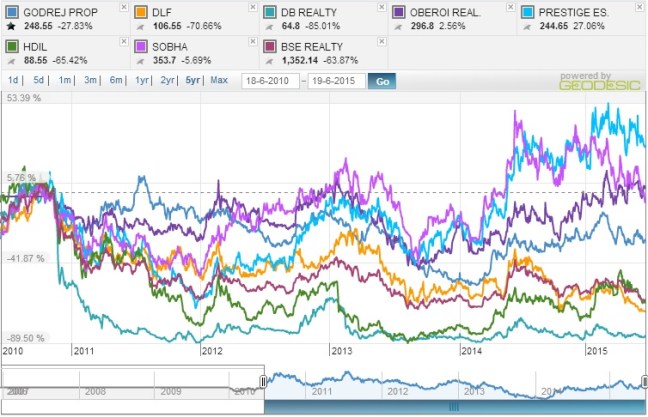
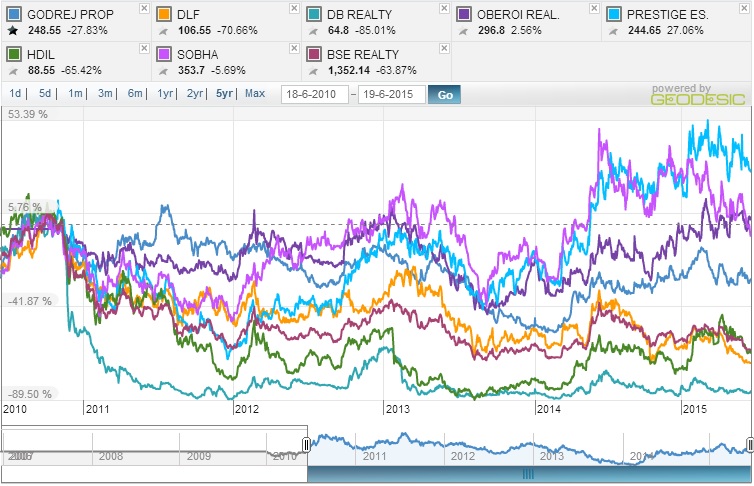
c. Option three — own real estate construction companies — just thinking about this sector brings about a bucket full or risks. Corruption to get permits, murky land deals, bad leverage on the balance sheets, shady managements, intense competition, deals that rip the eye balls of customers etc. the bucket keeps filling up. The real estate index has returned (32)%, (16)% and (64)% in the last 1, 2 and 5 year horizon. It is this big negative numbers that caught our attention. When a sector is this beaten down, the chances are it has also influenced some of the good companies to some extent as well. We do want to wade through this sewer to see if there are any good bets that might work out in the long run.  Below are the charts that show the performance of the bigger real estate companies and the index over these horizons.
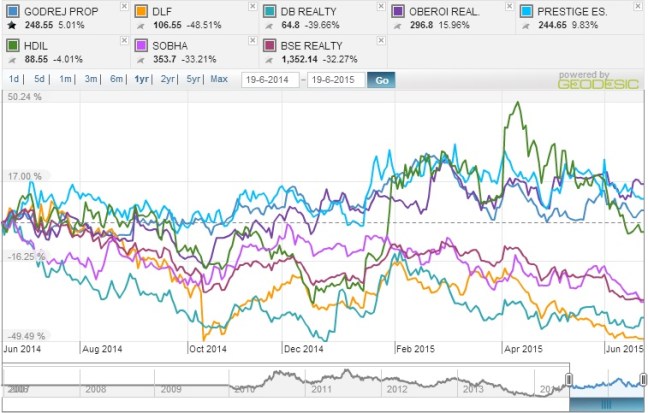
1 Yr RE

3 Yr RE

5 Yr RE

Over the next few weeks, we will be working on publishing a series of posts looking at the risks of investing here and also into the individual companies. If one closely looks at the five year performance of the real estate companies, hardly any value has been created. Investors have been carrying return free risk for 5 years adjusted for inflation. Not a single company has been able to create value as compared to fixed deposits as well over the same time frame. Prestige estates has been one of the better ones (we have not included Ashiana housing that we own as we think it is an outlier) with 27% return over 5 years. We will be looking into some of these companies over the next few posts. What we are looking for is for no debt to very conservative debt, no dilution, robust business models and good managements. If we do not get these characteristics, we will pass on the sector. However, we do intend to pass on companies like DLF, DB Realty and HDIL where a very cursory question rises more questions than answers.

More to follow….

Godrej Properties — Shareholder Value Creation or Owner Value Creation!!!!

Godrej is the second most trusted brand in India. The real estate arm has been executing on a string of exciting projects and been getting on a bigger and bigger treadmill on execution. The company is often touted by investors to grow 10X in the next ten years. The company projects itself having a differentiated, asset light model.

A brief look at the latest shareholder presentation here will reveal all the projects that the company is executing complete with beautiful pictures of the projects being executed like the one seen below.

Godrej

Picture of Godrej Central in Mumbai

A close look at the project pipeline and string of projects that the company is executing leaves in no doubt that the company has got the potential to grow 10X in the next ten years.

The bigger question is how have the shareholders fared during this time?

Godrej_Stock

In the last five years, Godrej Properties has returned (1)% compared to +55% and +56% for Sensex and Nifty. The realty sector has been in a recession and has returned (56)% in the last five years. While the shares have fared better than the BSE realty, it has not created any shareholder value in the last five years. Given that one could have earned 8% on deposits, a shareholders have assumed a return free risk of 46% (8% compounded over 5 years) One might make the argument that the company does not control the share price and lots of investors might have paid a high price for the stock back in five years. So, we will just let the facts rest and move to the next step.

Let us hold the management responsible for capital allocation and ensuring the fundamentals are creating shareholder value for the long run. Like we have seen before here, paying a dear price even for a good asset will risk the returns you get from it.

A look at the shareholders presentation will reveal the following two charts from the management

Godrej Financials

Looks impressive? Until you realize what it took for them to deliver this growth and profit. The below chart shows share outstanding and EPS delivered on the above growth.  While some like to adjust the stocks splits backwards, I have just done this forward.

2010 2011 2012 2013 2014 2015    
  69.85 69.85 78.04 78.05 199.23 199.23 Adjust Adjust 2
          99.615 99.615 Vikhroli Deal 75%
SOUS (mil) 69.85 69.85 78.04 78.05 99.615 99.615 107.985 110.085
SOUS (Crores) 6.985 6.985 7.804 7.805 9.9615 9.9615 107.985 11.0085
N/P (Crores) 122 130 98 138 159 191 191
EPS 17.466 18.6113 12.5577 17.681 15.9615 19.1738 17.35

The company has been diluting shares outstanding at the rate of 9.5% CAGR for the last five years. It is just a staggering number.

One might make the argument that one need to participate in the rights issue and cannot consider it a dilution. If one needs to keep pumping more money just to maintain one’s share, it is share dilution, under any other name like QIP, capital raising, rights etc. This means that the company needs to be growing earnings at 9.5% just to maintain the same level of earnings.  And wait till you hear this, the cost of debt for the company is 11.8% and yes, the debt levels have been going up as well. Short term debt is at 2,700 crores and long term debt at 300 crores at March 2015. The bigger piece of problem is that the inventories have gone up by 1,000 crores between 2014 and 2015 and is now standing at ~4,700 crores.The share holder equity in the company after the repeated capital infusion is 1,850 crores. So, the company has using shareholder money, bank debt and advance money from owners of current projects to bankroll future projects construction and land inventory. So, much for the differentiated asset light model and so much for the growth touted in the presentations.

While a rosy eyed investor can look at the assets of Vikhroli and say that the purchase was a bargain, it was for Godrej Industries and the promoters but not for the minority shareholders. While we do not dispute that the potential of Godrej to grow 10X in the next 10 years, we do share our skepticism on how much actual shareholder value will created in the process.

Disclosure: Own Godrej Properties. Evaluating whether it is a mistake.

ITC’s Use of Cash

ITC has this great cash engine called Tobacco. I dug a little bit into the published 2015 results to see how ITC was using its cash.

There is good news and bad news. Bad news — Cash from Cigarettes which generated ~180%+ ROC is being used to fund FMCG and Hotels business where if the ROC is ~1% in 2015. 90% of the additional capital in ITC went into FMCG or the Hotels business. While one might argue that FMCG will make money in the long run, the hotels choice is a bizarre one as it is cyclical and a low return business. Also, they paid 500 Crores for a property in Goa that is being challenged in the courts right now. Was 2015 an anomaly on how much capital went to hotels or will this be a trend? While one might hope a more prudent allocation in the future, it is something one definitely must be concerned about. Also, a clear road to profitability on FMCG will help as well. Good News — 700 Crores out of the 1,500 Crores that were invested came from other parts of the balance sheet like deferred taxes, better TWC etc. Essentially only 900 Crores or 10% of net profit went into capital for in all FMCG and Hotels. Glass half full or half empty?

All Numbers in Crores INR
ITC Last 12 Month Net Profit 9765
Depreciation 1027
Owners Earnings Before Capex 10792
Dividends 5621
Net of Dividends 5171
Additional Capital Employed % of Capital Employed 2014-2015 ROC of Segments
Capital Employed in Cigarettes 121 8% 183%
Capital Employed in FMCG 632 40% 0.8%
Capital Employed in Hotels 769 48% 1.1%
Capital Employed in Agri -79 -5% 44.1%
Capital Employed in Papers 110 7% 17.0%
Capital Employed in Others 41 3% 32.6%
Total Capital Into Business 1594 31%
Net Capital Left After Investing in Business 3577
Additional Cash in Balance Sheet Compared to 2014 4299 Additional cash coming in from better Deferred Taxes, TWC, Cash Management etc;

Nestle and ITC

Nestle

Maharastra government joined forces with a few other states banning Nestle’s Maggi creating a classic case of the government attacking a well entrenched moat Here

While it will take a while to sort this out, there is an air of uncertainty around Nestle’s flagship product in India. The biggest asset that Nestle carries on its balance sheet is its brand and this controversy puts Nestle’s most precious asset into the cross hairs. While the company has definitely the in-depth resources and financial wherewithal to survive the crisis, it still remains to be unknown as to the extent to which the moat will be breached. As warren says, ‘You only know who is swimming naked when the tide goes out’, this episode will really test the endurance and reputation of Nestle in India.  Even with the recent dip of 18%, the stock continues to enjoy a PE of 47, which takes the earnings yield just north of 2% making it a very expensive proposition even today.

While one might look at companies like Coca Cola which have faced such issues globally before and have emerged our relatively robust earnings power for the future here  Nestle still does not have the margin of safety required to evaluate Nestle fully. It must also be noted, there is a new breed of investors (the Buffett clones) who are watching quality companies with one-time resolvable issues to take advantage of the discrepancies that occur with these companies including Sanjay Bakshi in India (latest update on Nestle here)

Disclosure: No Position

ITC

We had written previously about ITC here.

In the recent market volatility that we have been seeing and with Maharastra (after Chandigarh) banning loose cigarettes, another stalwart in the FMCG space is fighting for the relevance of its business model and its flagship products (here). The company is trading at 25 times earnings or 4% earnings yield. With the excise duty hikes and the resilience that we have seen in the past with respect to the business model, it might be worth another look to see whether this stalwart is worthy at the current prices.

Disclosure: Long ITC

J&K Bank

J&K Bank has been in our radar since Mohnish Pabrai scooped up around 2.5% of the bank last October. We have been watching as frauds hit J&K bank and also the floods increased the NPA’s for the bank. As of May 25th, the bank had a market cap of INR 5,150 crores.

When one looks at the full year results, ROA’s are down from 1.74% to 0.7%; NPA’s are up to 2.77% from 0.22%; the provisioning is down from 90% to 60%. While the state government backs the bank and will not let it fail, it does look like all the bad news might not be out of the way, more NPA’s and bad debts might start showing up as we head into 2016. At an earnings yield of 10% and 0.8 times book, the bank might not be as alluring as the metrics make it look. The NIM for the bank is 3.81% in 2015 and the net NPA’s are at 2.77% with not so conservative provisioning and a leverage of ~1:7. There is only a thin line between making money and losing net worth in the banking business (as the shriram transport demonstrates here for Shriram Equipment Financing) One needs to pay close attention to underlying assets and the restructured book as one considers the bank.

Disclosure: No position

Shriram Transport Finance and Leverage

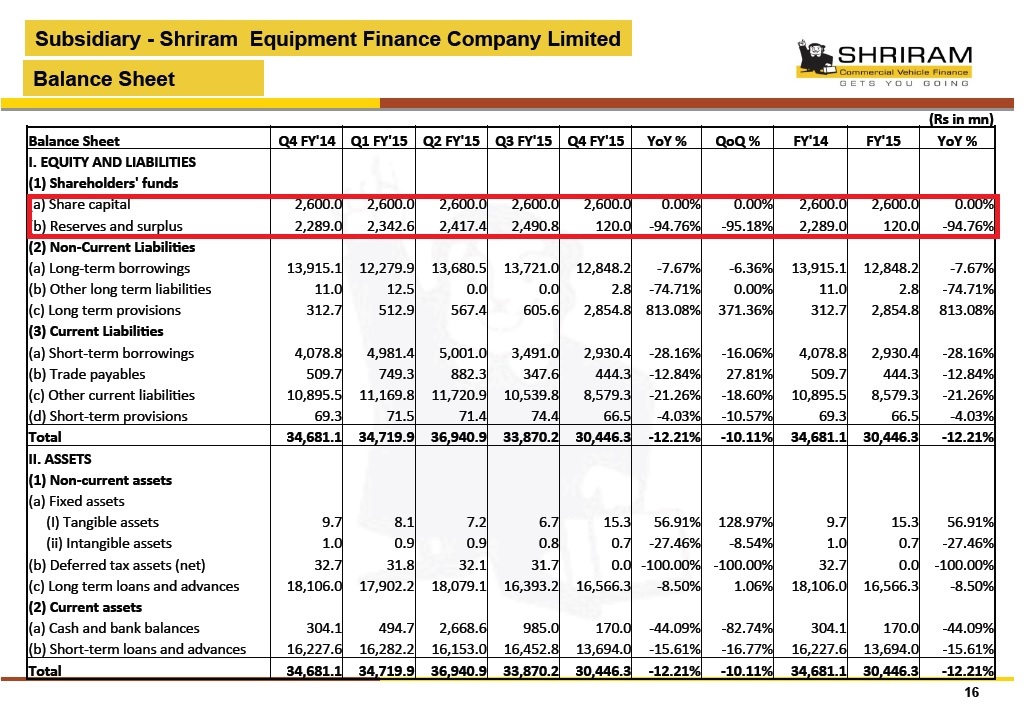
Shriram Transport Finance reported abysmal numbers in Q4 2015 with EPS down 74% compared to same quarter last year largely driven by the write off it had to take in one of its subsidiaries, Shriram Equipment Finance. Shriram Equipment Finance, established in 2009, lends to the construction industry for  machinery equipments like cranes, forklifts, loaders etc. required to do the construction work. Over the years, the company had been reporting steady profits, book value growth and asset quality. Backed by the conservativeness of the accounting the management had followed in the past, the management pedigree and the high CAR ratios, there was little reason to worry before this quarter.

Then WHAM!!!

Shriram Equipment

The company provisioned around INR 2300 Million up above 900% from last quarter. It basically provisioned  95% of all the net worth that it had garnered still its establishment in 2009. With this provisioning, the coverage ratio is still at 60%. While the company is hopeful that the construction business will pick up and they will recover the debts, it also means some more pain might be in order if the construction activity does not pick up.

This is a good lesson on how leverage can affect the results drastically both ways. While we have always emphasized that the finance business is only as good as the conservativeness of accounting and the pedigree of the management, it is an eye-opener on how quickly the game can change in the face of a bad quarter. While it is tough to absolve the management on why they did not see it coming, investors can breathe a little easy as Shriram Equipment Finance makes up a small portion of the total Shriram Transport Finance group. However, given the leverage, it managed to write off three quarters of the profit of the parent company. It is a hard reminder on how easy it is to lull oneself into believing that good returns are in order in the lending business.

Disclosure: Long Shriram Transport Finance

ITC

“I’ll tell you why I like the cigarette business. It costs a penny to make. Sell it for a dollar. It’s addictive. And there’s fantastic brand loyalty.”
— Warren Buffett, ‘Barbarians at the Gate’ on RJR Nabisco

Cigarette company discussions often start and end on moral stands that investors take about tobacco usage. While we will leave the individual preferences to the respective investors to evaluate and act upon, we will discuss a bit about ITC which commands over 75% share in the legal Indian cigarette industry.

Cigarette businesses comes with investment characteristics that are highly desirable (leaving aside the moral question of public good or increasing the value of the ecosystem they operate in)

  •  Cost a penny and can be sold for a dollar
  • Great brand loyalty
  • Government restrictions on ads and regulations means it is legally very tough to take market share away from incumbent players
  • India still does not suffer from the punitive legal hurdles present in the western world

ITC however has been going through a different challenge. Over 85% of Indian tobacco consumption is not legal or not subject to regulation. This has meant that companies like ITC bear the burnt of the high excise taxes which are increasing every year and VAT as well. Smaller companies that operate outside the legal boundaries have a huge cost advantage over the ITC’s of the world. If the government does get serious about tobacco usage and curbs the usage of illegal tobacco, it might actually strengthen ITC’s business model. Though, the chances are slim and might take a few years at least.

Currently, ITC is suffering a huge volume decline on the back of the big tax hike in the last few years. The volume decline has accelerated in the last two quarters. There is a possibility that the demand is not as inelastic as we believe it to be.

2014 2015
Q1 Q2 Q3 Q4 Q1 Q2 Q3 Q4
-2% -4% -2% -3% -3% -4% -13% -13%

In the backdrop of this, the already weak shares of ITC might see further weakness of the next few quarters. While we are not predicting the short term stock movements, as long term holders, we are hoping for a sale in ITC stock.

There are two catalysts that we see in the long run

  •  The sustainability of the cigarette over the longer period of time and its robustness. You cannot kill this business model except by banning cigarettes in India.
  • The cash engine ten years from now will be from FMCG along with Cigarettes that will ensure that the sustainability of the model will continue for the future. This change while tough to evaluate from a cash flow perspective is rather easy to evaluate from a predictability perspective.

You have a good cash cow, a new growth engine (yet to see cash flows though), a terrific management and a solid business model with a fair amount of predictability. For a long term investor, who does not care about short term weakness, price declines and can be  contrarian, some pain might be in order but definitely commands a look.

Disclosure: Long ITC