Weekend in Omaha – Berkshire and Markel meetings

Spent the weekend in Omaha after 12 long years. It was a weekend worth its time. It’s a place to reflect and see the vision of some of the leaders who share openly and give more than they need to . These are not comprehensive notes but some key notes from the different meetings.

Tom Gayner has some interesting nuggets to add during the Markel Brunch:

  1. On Cyber Insurance: The limits are small and understands the aggregation risks well. Ajit Jain in Berkshire is worried about writing large risks like cloud cyber security where as Markel specializes with much smaller limits and understands aggregation well. Markel is in a different space on cyber insurance compared to Berkshire.
  2. On Berkshire selling Markel: Learnt about in 13F when it was bought. Thought it was a housekeeping seal of approval. Learnt about it on 13F when it was sold. Does not have any insights on Berkshire’s actions but is buying Markel with his own capital because he thinks its undervalued. Re-iterated a couple of times that Markel is trading much lower than his estimate of intrinsic value. Was pretty open about it.
  3. Direct question on EBITDA as bullshit earnings: Charlie says what Charlie says. Gave an example of how book value of Coca Cola is $6/share where market price is $60/share. When you buy BRK at 1.5BV, you are essentially buying at $90/share and when you buy MKL that owns BRK at 1.3 or 1.4 times earnings, the value is essentially different as well. The key is to be able to bridge it to cash earnings at the end of the day. Made me think quite a bit about owning Markel and what AAPL earnings yield was on that (through the Berkshire holding) given that AAPL itself is close to 3% annualized earnings yield.
  4. Combined Ratio: is important but need to see it in combination with how many years have the reserves and estimates of losses been below the estimates. Markel (and Berkshire) are very conservative and have great records.
  5. The combined ratio discussions got me personally thinking about in this more higher interest rate environment, where the borrowing cost for the US govt is 4-5 pts, we have a business model (both Markel and Berkshire) which earns around 2-4 pts on combined ratio and can borrow at 700-800 bps of spread to the US govt. Even if the portfolio generates the same returns as the S&P 500, the risk levels must be meaningfully lower.
  6. Vision for Markel: Spent a bit of time talking capital allocation and the vision for Markel with the three engines on Insurance, portfolio and ventures. I think Gayner is set on accelerating the ventures a lot more aggressively and really go after the mini-Berkshire model. We might finally see his stamp in transforming this from a stodgy conservative insurer to a mini-Berkshire. Noted that they would probably not be doing acquisitions that will double their size or so.

Ajit Jain: Was sharp as a tack and came across as very direct, blunt and razor sharp in his thinking.

  1. Succession: Warren reiterated there cannot be another Ajit. Ajit claims he is building leaders to succeed him when the time comes.
  2. Cyber insurance: Spoke about the aggregation of risks and issues with writing large deals on cyber insurance like cloud cyber attacks and issues with estimating the losses on them. Reiterated that Berkshire considers that money is lost every time a cyber policy is written.
  3. Climate Change: All policies are priced yearly. Climate change like inflation will be the friend of the risk bearer provided its priced appropriately.
  4. Geico: This was probably the most disappointing piece of Ajit’s comments. Reiterated that Geico is still behind, building up infrastructure and will have systems and infra ready by 2025. Warren noted Geico is still the lowest cost player and there is no risk of failing or even losing profitability. It felt as though the entire discussion was defensive in nature. In contrast, Geico in the past has always been heralded as a wonderful company where the moat was widening; the comments made it clear that the moat is shrinking and the management at best has a strategy to catch up.

Greg Abel: Was composed, solid as a rock. Created the right impression that he was the right next leader for Berkshire.

  1. Management: Leaders are talking to him and more engagement with the operating managers on running the business.
  2. Pacific Power: reiterated along with Warren that they will not throw good money after that. Separated out good regulatory states like Utah versus Oregon and California. Utah caps economic claims. Oregon lawsuits and claims are adding up but does not think they have much merit. Regulatory reform much chance in the western states.
  3. BNSF: acknowledged that BNSF had the worst operating ratio of the 5 class 1 carriers. Sounded a lot like the Geico discussion. Felt like the moat was shrinking rather than increasing for the business. There could be two tacts to this: a. Underpromise and overdeliver b. Or the business is indeed losing its widening moat position. Only time will tell.

Tracy Britt Cool: Kanbrick capital. More hands on approach to management and create opportunities in mid size companies using private capital. 5 years as investor in Berkshire, 5 years as operator and now in Kanbrick. Talked about being an investor, operator made her a better capital allocator.

  1. Pampered Chef: In Berkshire, she served as CEO of Pampered Chef. The business had run down from $700M to $300M in the decade before she stepped in. Made me wonder quite a bit about the decentralized model of Berkshire and how problems remain undetected for so long making tough turnarounds even tougher. Even though Todd Combs is at Geico and BNSF is being worked over, made me think of parallels whether the decentralized ownership led to some for the shrinking of the moats in the two pillars of Berkshire.
  2. Private Equity: Kanbrick runs as a private equity. It was not clear how the capital structure ensured long term capital because the key pitch was that they invested in things that take time that normal public companies could not or would not have the patience to invest in.
  3. Kanbrick business system: Has a business system similar to Danahear around Systems, people, operating models and KPIs to enable mid size companies to operate and standardize. Works for most companies except some companies that relied on creative talents.

Warren Buffett: Lots of repeat comments from prior meetings. Few evasive answers. Some average questions from the crowd but Becky’s questions were good. A couple of aww shucks moments when he looked around for Charlie and ended the meeting hoping that he would come back next year.

  1. Apple Sales: More of them coming? Warren hinted that they would end at $200B at end of Q2 2024. They had $181B at end of Q1. $8-9B from operating earnings leaves them around $10B of potential AAPL sales. A possibility for sure given his comments on APPL.
  2. Paramount: Owned up that neither Todd or Ted had anything to do with it. Then he made one of those profound statements that Warren makes (remember how he referred to iPhone as the single most important piece of real estate for every human being that the individual treasured) and said it made him think about how people spent their leisure time and how that has changed over time.
  3. AI: Every reference to AI had a reference to Nuclear weapons. Clear that he sees the risks a lot more deeply than the general population does. Talked about deep fake AI video of him saying things he never uttered. Called scamming a growth industry.

Charlie was missed. Warren Buffett is walking around with a cane. Ajit Jain’s shaking on his hands that I had noticed before was not visible this time around. Tom Garner seems very upbeat about Markel’s prospects.

Edge

About three years ago, during the onset of the pandemic, I was often left wondering where I was going to be getting my edge in creating wealth that is needed to have a path to financial independence. Financial edge in the field of investment was elusive and not yielding major delta over the indices to create enough alpha for the time I was spending on it. After loads of solitary walks, I figured out that the best edge that I had over virtually everyone else was in the knowledge of the job that I was in and the out-executing everyone in the work in front of me. It was something I could action; the opportunity was there and I threw everything and the kitchen sink at it. I pivoted and attacked it with a sense of urgency and value creation with all the energy that I could possibly muster. Started gradually moving from individual stock selection to more towards a conservative portfolio with more cash, more index funds and select stocks like BRK which I understood well.

It was scary to acknowledge that I had no real edge over the market. At the same time, it was not clear that pouring more energy will result in better outcome in my job. Over the last 3 years, my income from work has multiplied several fold (prompted by two big promotions), the portfolio continues to be conservative but continues to provide decent returns from the index funds and the underlying simplicity with a huge surplus of time that I have been able to invest back in family and work. The underperformance of the portfolio compared to the market due to the cash component (t-bills and bonds of course) is more than compensated by the progress on the work front.

Was it clear this was going to be the outcome? Of course not. One had to leap to find out. To each is own, but this pivot really paid dividends for me. It all started with destroying my own idea that my edge would come from investing.

Berkshire adds index funds?

Something peculiar caught my eye in the Berkshire 13F filing this quarter. It is a very small holding and completely irrelevant given the size of the equity portfolio for Berkshire. The position is sized at a little over $25M and is too small even for Berkshire’s two investment managers, Todd and Ted. However, this is the first time to the best of my knowledge that Berkshire has purchased the S&P index (SPDR and the Vanguard S&P 500 ETF) as part of its main portfolio.

Time will tell whether this is the beginning of Berkshire deploying excess cash through an index fund or just a small position with no relevance in the bigger picture. While Warren Buffet has long been a proponent of S&P index for general investors, this is the first time he has used it as part of Berkshire’s portfolio.

13-f Link here

Consolidated portfolio changes from Dataroma (here)

Piramal Watch

On Friday, Piramal announced the sale of DRG, the healthcare focussed IT analytics firm, to Clarivate for $950M. With this, Piramal will receive $900M at the close of the deal and $50M 12 months after the deal closure. You can find the press release here. More interestingly, you can find, Clarivate’s presentation on the deal here

Coupled with the rights issue and CCD worth about $770M, Piramal will have raised around $1.6B in capital starting October 2019 (provided the Rights issue, underwritten by the promoters, go through successfully). In addition, the reliance away from commercial paper into longer term bank loans and the proceeds from the sale of STFC, will play a key role in improving the liquidity position and the balance sheet of Piramal significantly. Coupled with the fact that the D/E of the business was low, total construction finance book a little over $4.3B, it looks like the balance is finally tilting in Piramal’s favour that will allow it to wait out the downturn in real estate while opening up a few offensive moves.

While the opportunity cost might be high, Piramal has long been a counter-cyclical investor and time will tell whether he can extend this to a leveraged financial model.

Disclosure: Long Piramal.

Disclaimers: here


Fairfax –Actions and Results Speak Louder than Words

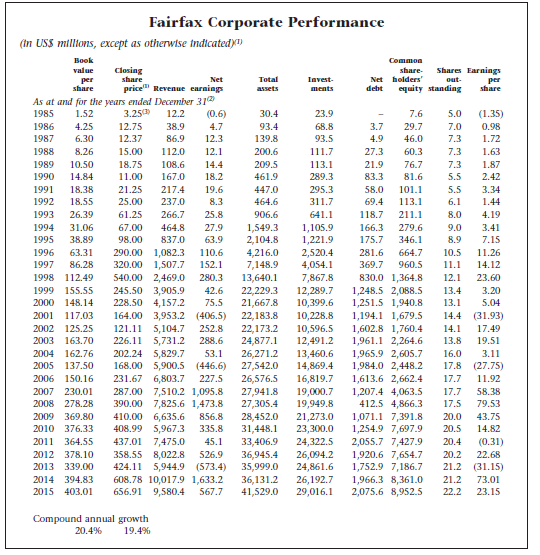
Fairfax is a global P&C insurance company led by its charismatic CEO, Prem Watsa, often dubbed as the Warren Buffett of Canada. Fairfax has compounded book value by 20.4% CAGR since inception and the stock price has closely followed it at a 19.4% CAGR. However, the recent performance has been anemic and  events have left a lot of questions unanswered about Fairfax.

frfhf-performance

Picture Source: 2015 Fairfax Annual Report

Fairfax Macro Position:

Fairfax has had a long history of making bold macro calls and producing returns for its investors. The most recent successful macro bet was during the great financial recession between 2007-2009. Fairfax was early in the macro call before the recession but profited handsomely when shocks permeated through the financial world.

gfr-position

Source: 2013 Annual Report

Coming out of the recession in 2010, Fairfax saw similarities between the 2008 recession and the 1929 depression and took a position based on the assumption that the recession story had not been completely played out. Fairfax took a bearish stance in two different ways, through derivatives linked to CPI’s and equity hedges on its portfolio. The CPI linked derivatives have been covered extensively in several places and is a key component to the bullish thesis on Fairfax. However, these are not the securities that have caused the under performance. It is the equity picks of Fairfax.

As we will see later, the under performance on the equity picks meant that the equity hedges kept Fairfax in a net short position in a bull market over the last several years.

Book Value per Share:

The book value per share compounded 2.6% CAGR between 2011 and 2015 for Fairfax. This can be separated into two different components. The shareholder’s equity has been compounding at 4.8% CAGR and the shares outstanding has been diluting at 2.1% CAGR over the last five years resulting in a net compounding of 2.6% over the five year horizon.

book-value-per-share

As with most insurance companies, Fairfax’s economic engine is driven by

  1. A profitable insurance underwriting company that generates benefit of float and a great capital structure,
  2. An investment portfolio consisting of bonds and stocks to generate leveraged returns for shareholders

Insurance operations at Fairfax:

Fairfax has a decent record of underwriting over the last five years. The company’s insurance operations have generated $954M of underwriting profit over the last five years. The insurance operations provides a capital structure that enables Fairfax to borrow cheaper than the government of Canada and get paid to hold the premiums in advance. As the tailwinds in the insurance markets continue, Fairfax will continue to benefit out of this. The capital structure is a great source of competitive advantage for insurance companies. I would like to cast the readers attention to our article on capital structure some time ago here.

Fairfax Insurance Returns.png

Investment Returns at Fairfax:

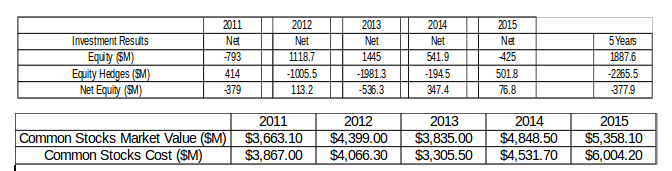
When one looks at the net result of realized and unrealized gains at Fairfax from 2011 to 2015, one would notice that the equity investments have lost Fairfax $378M over the last five years. This mediocre performance has been driven by the under performance of the equity that Fairfax has invested in as compared to the strength of the bull market in general over the last five years. In addition to this, the CPI linked derivatives have cost another $436M to shareholders. However, given the extreme pay off ratio if some of these bets do realize probably makes them a speculative risk worth considering given Fairfax’s long term macro record.

fairfax-equity-returns

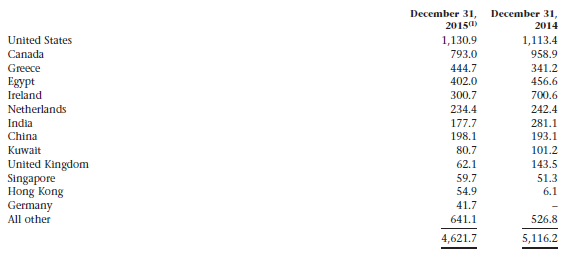
At the end of 2015, the value of market investments for Fairfax was about $650M below the cost of the investments. This is before any equity hedges or derivatives causing further deterioration. The common stock exposure (below table excludes funds that are common stock investment funds that primarily has fixed income bonds) shows that close about 40% of the common stocks are held in the US and Canada. There is a significant exposure to stock markets in Greece, Egypt, Ireland, India, China and Kuwait. This is not something for the fainthearted. There are two ways to look at this, the brighter side is that these markets could be a source of alpha, and on the less brighter side, these could result in a host of political, volatility and currency risks.

frfhf-equity-investments

We looked through the most recent 13-f filings for Fairfax’s performance of its long positions in the US.

Fairfax US Positions.png

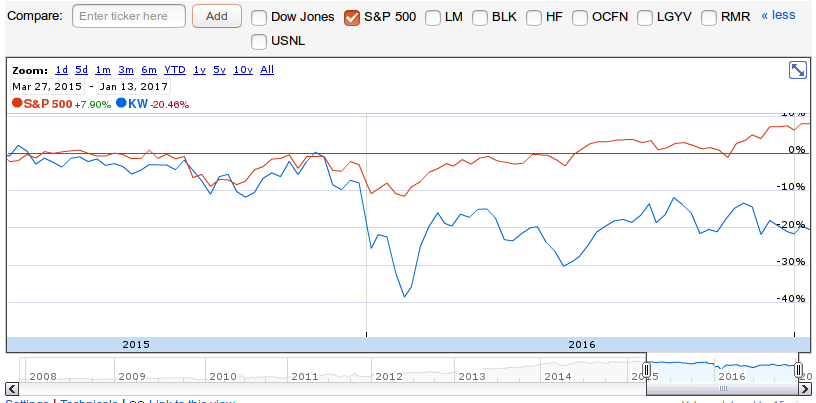
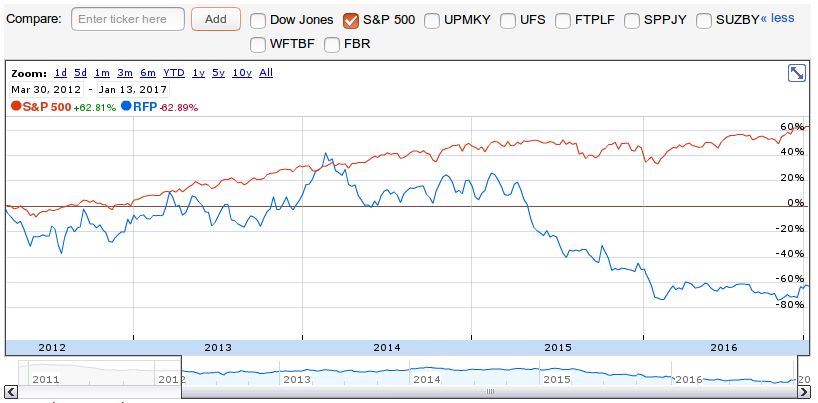
The four positions in the US make up around 83% of the reported US equity portfolio. Their performance has not been inspiring. We looked up the buying period when Fairfax added these positions and their relative performance against the S&P 500.

bbryfrfhfibmfrfhfkwfrfhfrfpfrfhf

In addition, we reproduce the below extract from the annual report for one of the biggest Greece investments for Fairfax.

frfh-greece-investments

The under performance of the equity picks from Fairfax as against the Russell and the S&P index has caused erosion in the value of the investments for Fairfax. Instead of hedging against equities, the poor long picks of Fairfax has landed them in a net short position that caused them to lose money ($377M) against the general market.

These risks continue to exist in Fairfax stocks today. After the recent election results, the equity hedging has been reduced to 50% from the 112% at the end of Sep, 2016. Unless the underlying picks start performing better, the returns from the equity side will continue to be anemic. The foreign markets risk is something a prudent investor must think carefully over before investing in Fairfax.

The bond portfolio:

With the great disconnect in mind, Fairfax piled on bonds in the anticipation of lower interest rates. With the recent interest rise hikes and the anticipation in the future, one needs to closely look at the duration of the bonds at Fairfax.

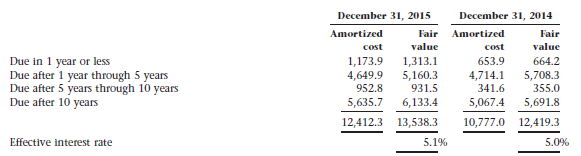
frfhf-bond-maturity

Close to half the bonds held at Fairfax have a maturity greater than 10 years which is result in interest rate sensitivity being high on the bond portfolio.

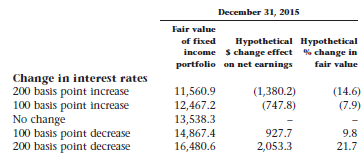
frfhf-interest-rate-sensitivity

Contrast this with Berkshire Hathaway where less than 10% of the bonds was have duration greater than 10 years.

brk-fixed-income-portfolio

Source: Berkshire Hathaway 10-K 2015

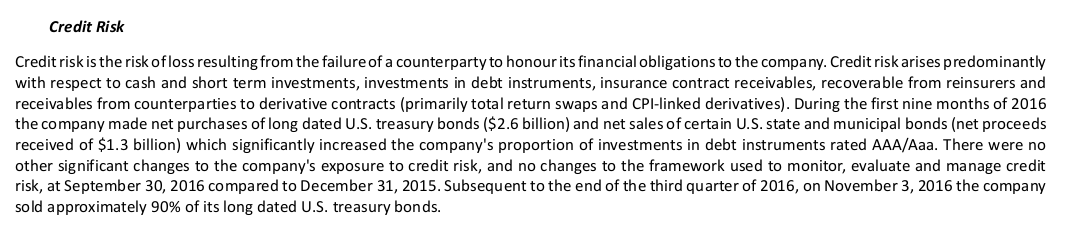
Correction: Subsequent to Q3, Fairfax sold 90% of long dated US treasuries which is about $5.6-$5.7B of Bonds. It will be interesting to see the use of cash subsequently as another source of profits in the last few years has dried up.

treasury-bonds

Allied World Acquisition:

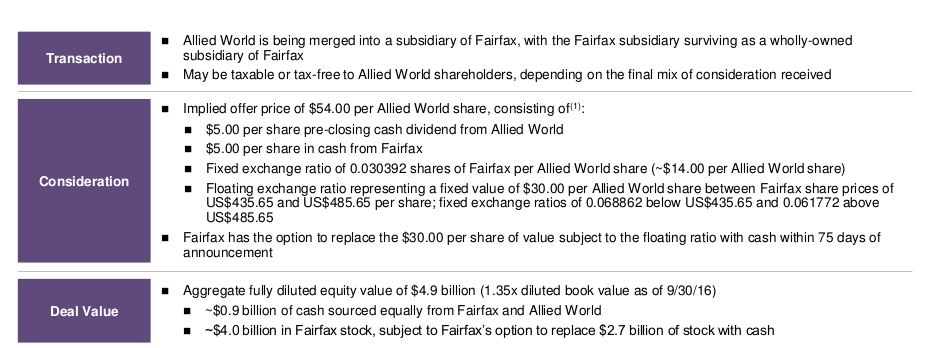
Fairfax announced the acquisition of Allied World for $4.9B or $54 per Allied Share. $10 of dividend from the cash between Fairfax and Allied World and the rest in the form of Fairfax shares. Essentially, $0.9B of cash between Fairfax and Allied and then $4.0B of Fairfax stock with an option to replace $2.7B of stock with cash within 75 days of the announcement. It was very interesting to see the conference call where it was announced that Allied would be decentralized and there are no cost synergies. So essentially Fairfax is paying between $435 and $485, a share implying a book value of 1.07 to 1.19 (9/30 2016 BVPS) to buy a company at 1.35 times book value.

allied-world-acquisition

Source: Allied Acquisition Slides

Okay. Here is an excerpt of the intrinsic value of Fairfax from the 2015 annual letter.

frfhf-intrinsic-value

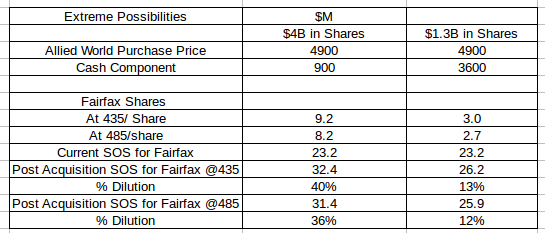
So, essentially, Fairfax took undervalued shares to buy Allied World at 1.35x book without any cost synergies. I do hope that Fairfax understand what they are getting in return. Given the long duration bond portfolio and the lackluster performance of the equity book, the additional float for investment cannot be solution to the problem. The current shareholders are going to be diluted anywhere between 12% and 41% through this acquisition.

Dilution.png

All the recent events and their performance raises more questions than answers. As a long term holder of Fairfax, I have to re-think a lot of the assumptions about Fairfax and this post is part of the evaluation. Any new buyers, caveat emptor.

Buffett on Reinsurance

Just a post to keep some notes on reinsurance to self.

The Berkshire Shareholders meeting had little in terms on new content though it was good to see that both Charlie and Warren razor sharp as ever.

Probably one of the most interesting insights came in the initial parts of the Q&A. Reinsurance. Berkshire Hathaway had sold down its position in Munich Re and Swiss Re in 2015. When asked a pointed question about it, Buffett was very articulate and gave two key reasons for it: a. Low to negative yields in Europe b. Surplus capacity in reinsurance industry.

In a way, Buffett was alluding to the fact that with hedge funds like Greenlight Re and Thirdpoint Re entering the reinsurance business and being hungry for float, it is likely that too much competition will make (or has made) pricing softer in the market. Supply up, demand is the same. This should raise two questions: a. Buffett is reducing exposure to the reinsurance business by reducing his stake, Greenlight Re and Thirdpoint Re are going long at the same time. One must thoroughly consider the consequences of betting against the man who built the most profitable reinsurance business in the world and has constantly reminded us that the insurance industry is survived the longest by those who walk away when pricing is not adequate to the risks taken. b. If there is going to be softer pricing in the market, investors in companies like Greenlight Re and Third Point re, not only have to tide over the cost of float but also the rich fees that the hedge funds rake in.  The two net cost adders might make the economics very difficult for investors to make meaningful returns unless the reinsurance companies have many home runs on the investment side.

With the low to negative yields, float becomes less valuable as the capital structure of many of the reinsurance business like Swiss Re and Munich Re allows them to invest float in only certain types of securities. Buffett is essentially betting that it will be tough for reinsurance companies to invest float in positive returns instruments for quite sometime to come. Unless of course, you are Prem Watsa and assume that deflation is going to take over in which case the bonds become very useful. Time will tell. Time to increase watch on the insurance holdings.

TRIP owned by Allan Mecham

Very interesting to see that Allan Mecham of Arlington value capital has been buying TRIP. See articles related to Allan Mecham here.

See our post on Trip Advisor here.

Period Shares % of Portfolio Activity % Change to Portfolio Reported Price
2015   Q4 324,040 3.48 Add 109.89% 1.82 $85.25
2015   Q3 154,389 1.31 Buy 1.31 $63.02

Source: dataroma.com

Sotheby

I got drawn towards Sotheby’s stock after watching a video where Jim Chanos claimed that he was short Sotheby (NYSE:BID) Jim interestingly alluded that it was a great way to bet on the economy as it catered to the 10% of the top 1% and that the stock hit $10 in every financial crisis. I decided to go through BID’s annual report to see what I could find.

Sotheby’s business can be divided into three segments: Agency, Principal and Financing.

The Agency business is where Sotheby matches buyers and sellers and cuts a premium from both at the end of the transaction. Sotheby’s sales in this segment was $825M out of the total $938M it reported for the company in 2014. It is a very high GP margin business with 88%  and uses about $2.3B of assets out of which $900M+ are receivables from customers from the busy Q4 season. The main cost drivers for this segment are  marketing & promotions to ensure that the right dealers and collectors are present during the collection. This has been the cash cow for the company and Sotheby’s has been seeing some serious competition from Christie’s on this. The  buyer’s commission and seller’s premium that Sotheby earns in a transaction is about 14.9% on average hammer price.

Sotheby’s main rival is Christie’s and both compete furiously. It is one of the oldest duopoly in the world and is predominantly a reputation business. Sotheby’s share of the auctions done between them and Christie’s is 47%. Both have taken on different strategies off late with Sotheby catering to the ultra luxury segment and bigger ticket items and Christie’s moving lower to give a more complete collection. While other competitors like Phillips exist, the faster growing rivals are in China and HK where both the companies have expanded their horizons through acquisitions. Both operate a classic business model where reputation matters, and in which a seller is attracted to a network that will connect them to the most prospective buyers and buyers are attracted to a network where the highest potential exists for a particular interesting and authentic piece of art.

Principal: In this segment, Sotheby’s puts up capital to buy art pieces opportunistically. However, the numbers tell a very different story. The company sold about $69M of art works under this segment and made about $1.9M in the process with a gross margins of 2.7%. The period for which this capital was locked is not very clear. It is only 8% of the business and sucks about $0.1B capital and is a low return business. Given the information that Sotheby’s holds in this entire process, it is very surprising to see the low return in this business. One must also wonder why they are doing this.

Finance: Here, Sotheby finances art with a LTV of < 50%. This is an very interesting segment, as cost of capital from a credit revolver is around 2% and they are lending at close to 10% per annum. GE capital has provided this revolver for Sotheby. Sotheby has loaned about $644M with $445M in debt at 2% and rest being equity. Their NPA’s have been negligible and past dues barely any. It is one of the bright spots of the company and about 4% of the revenues are drawn from here.

At a consolidated level, Sotheby carries a debt of $2.3B of debt with $1.0B due to sellers after getting payment from buyers; $230M of mortgage for a NY properly that is adequately secured and $450M of loan from the credit revolver facilities making up the major chunk of the debt. On the asset side, this is compensated by close to $700M of cash, $900M of accounts receivable (they don’t have an obligation except where they have provided guarantees unless the buyer pays) and $698M of receivables from the financing segment.

Sotheby trades at $2.3B of market cap ($32 per share) at the time of writing. Net Income for the 2014 was $117M and $143M when you adjust for the third point activism charges that they incurred in 2014 or $2 adjusted EPS. It looks a decent franchise which will continue to play a leading role in the art world.

There are two big catches to this story:

a. Given the free monetary policies around the world, asset prices are inflated and art pieces are no exception. During the previous recessions, these companies have had really tough times moving stuff through their auction houses. Given the current state of the economy, investing in this would be a straight forward bet on the economy that it would do well.

b. The free cash flow of Sotheby has been anemic. In the last three years, it has generated about $162M of free cash flow with an average of $54M per year as compared to GAAP earnings which is closer to the $120M mark. The main culprit here in the working capital of the business, with receivables and inventory ballooning up faster than sales. It use last three years average FCF; the stock is trading north of 40 times the average FCF generated by the business.

While we do not typically short stocks, we thought it is an interesting idea to hold in the back pocket if it indeed gets any cheaper from a FCF or an owner’s earnings perspective. I must however comment that I am inclined to think favorably towards  Jim Chanos’s view of Sotheby  being a proxy economic indicator of the economy.