Weekend in Omaha – Berkshire and Markel meetings

Spent the weekend in Omaha after 12 long years. It was a weekend worth its time. It’s a place to reflect and see the vision of some of the leaders who share openly and give more than they need to . These are not comprehensive notes but some key notes from the different meetings.

Tom Gayner has some interesting nuggets to add during the Markel Brunch:

  1. On Cyber Insurance: The limits are small and understands the aggregation risks well. Ajit Jain in Berkshire is worried about writing large risks like cloud cyber security where as Markel specializes with much smaller limits and understands aggregation well. Markel is in a different space on cyber insurance compared to Berkshire.
  2. On Berkshire selling Markel: Learnt about in 13F when it was bought. Thought it was a housekeeping seal of approval. Learnt about it on 13F when it was sold. Does not have any insights on Berkshire’s actions but is buying Markel with his own capital because he thinks its undervalued. Re-iterated a couple of times that Markel is trading much lower than his estimate of intrinsic value. Was pretty open about it.
  3. Direct question on EBITDA as bullshit earnings: Charlie says what Charlie says. Gave an example of how book value of Coca Cola is $6/share where market price is $60/share. When you buy BRK at 1.5BV, you are essentially buying at $90/share and when you buy MKL that owns BRK at 1.3 or 1.4 times earnings, the value is essentially different as well. The key is to be able to bridge it to cash earnings at the end of the day. Made me think quite a bit about owning Markel and what AAPL earnings yield was on that (through the Berkshire holding) given that AAPL itself is close to 3% annualized earnings yield.
  4. Combined Ratio: is important but need to see it in combination with how many years have the reserves and estimates of losses been below the estimates. Markel (and Berkshire) are very conservative and have great records.
  5. The combined ratio discussions got me personally thinking about in this more higher interest rate environment, where the borrowing cost for the US govt is 4-5 pts, we have a business model (both Markel and Berkshire) which earns around 2-4 pts on combined ratio and can borrow at 700-800 bps of spread to the US govt. Even if the portfolio generates the same returns as the S&P 500, the risk levels must be meaningfully lower.
  6. Vision for Markel: Spent a bit of time talking capital allocation and the vision for Markel with the three engines on Insurance, portfolio and ventures. I think Gayner is set on accelerating the ventures a lot more aggressively and really go after the mini-Berkshire model. We might finally see his stamp in transforming this from a stodgy conservative insurer to a mini-Berkshire. Noted that they would probably not be doing acquisitions that will double their size or so.

Ajit Jain: Was sharp as a tack and came across as very direct, blunt and razor sharp in his thinking.

  1. Succession: Warren reiterated there cannot be another Ajit. Ajit claims he is building leaders to succeed him when the time comes.
  2. Cyber insurance: Spoke about the aggregation of risks and issues with writing large deals on cyber insurance like cloud cyber attacks and issues with estimating the losses on them. Reiterated that Berkshire considers that money is lost every time a cyber policy is written.
  3. Climate Change: All policies are priced yearly. Climate change like inflation will be the friend of the risk bearer provided its priced appropriately.
  4. Geico: This was probably the most disappointing piece of Ajit’s comments. Reiterated that Geico is still behind, building up infrastructure and will have systems and infra ready by 2025. Warren noted Geico is still the lowest cost player and there is no risk of failing or even losing profitability. It felt as though the entire discussion was defensive in nature. In contrast, Geico in the past has always been heralded as a wonderful company where the moat was widening; the comments made it clear that the moat is shrinking and the management at best has a strategy to catch up.

Greg Abel: Was composed, solid as a rock. Created the right impression that he was the right next leader for Berkshire.

  1. Management: Leaders are talking to him and more engagement with the operating managers on running the business.
  2. Pacific Power: reiterated along with Warren that they will not throw good money after that. Separated out good regulatory states like Utah versus Oregon and California. Utah caps economic claims. Oregon lawsuits and claims are adding up but does not think they have much merit. Regulatory reform much chance in the western states.
  3. BNSF: acknowledged that BNSF had the worst operating ratio of the 5 class 1 carriers. Sounded a lot like the Geico discussion. Felt like the moat was shrinking rather than increasing for the business. There could be two tacts to this: a. Underpromise and overdeliver b. Or the business is indeed losing its widening moat position. Only time will tell.

Tracy Britt Cool: Kanbrick capital. More hands on approach to management and create opportunities in mid size companies using private capital. 5 years as investor in Berkshire, 5 years as operator and now in Kanbrick. Talked about being an investor, operator made her a better capital allocator.

  1. Pampered Chef: In Berkshire, she served as CEO of Pampered Chef. The business had run down from $700M to $300M in the decade before she stepped in. Made me wonder quite a bit about the decentralized model of Berkshire and how problems remain undetected for so long making tough turnarounds even tougher. Even though Todd Combs is at Geico and BNSF is being worked over, made me think of parallels whether the decentralized ownership led to some for the shrinking of the moats in the two pillars of Berkshire.
  2. Private Equity: Kanbrick runs as a private equity. It was not clear how the capital structure ensured long term capital because the key pitch was that they invested in things that take time that normal public companies could not or would not have the patience to invest in.
  3. Kanbrick business system: Has a business system similar to Danahear around Systems, people, operating models and KPIs to enable mid size companies to operate and standardize. Works for most companies except some companies that relied on creative talents.

Warren Buffett: Lots of repeat comments from prior meetings. Few evasive answers. Some average questions from the crowd but Becky’s questions were good. A couple of aww shucks moments when he looked around for Charlie and ended the meeting hoping that he would come back next year.

  1. Apple Sales: More of them coming? Warren hinted that they would end at $200B at end of Q2 2024. They had $181B at end of Q1. $8-9B from operating earnings leaves them around $10B of potential AAPL sales. A possibility for sure given his comments on APPL.
  2. Paramount: Owned up that neither Todd or Ted had anything to do with it. Then he made one of those profound statements that Warren makes (remember how he referred to iPhone as the single most important piece of real estate for every human being that the individual treasured) and said it made him think about how people spent their leisure time and how that has changed over time.
  3. AI: Every reference to AI had a reference to Nuclear weapons. Clear that he sees the risks a lot more deeply than the general population does. Talked about deep fake AI video of him saying things he never uttered. Called scamming a growth industry.

Charlie was missed. Warren Buffett is walking around with a cane. Ajit Jain’s shaking on his hands that I had noticed before was not visible this time around. Tom Garner seems very upbeat about Markel’s prospects.

Charlie Munger – RIP

At a time where few heroes live up to their ideals, Charlie stood both the test of time and the challenges of living up to these ideals consistently. In an age marked by compromise and shifting boundaries, Charlie remained steadfast to his ideals, principles and multi disciplinary learning that guided his life.

After receiving the news of Munger’s passing, it took several days for me to compose my thoughts. A part of me is yet to fully accept that he will no longer grace the table at Berkshire’s annual meetings, a familiar sight with his peanut brittle and Coke, always ready with his sharp, witty zingers. Though it is a rational conclusion for a life as rich and full as his, the wisdom he imparted remains timeless, continuing to resonate and stand the test of time.

A hero in every sense of the word. RIP Charlie! And here’s a toast to your next chapter as the eminent dead where your teaching will stand through the test of times.

Li Lu watch & Balance Sheet Recession!

We had posted about Li Lu and his efforts to gather data from China with observations on the Covid issue (here) Li Lu is largely credited with bringing BYD to the attention of Charlie Munger, Sokol and then Warren Buffett following which Berkshire bought a stake in BYD.

In nov 2019, Li Lu published an essay in Mandarin on China. A couple of bloggers recently translated that article and you can find it here. It is quite a fascinating read.  It prominently refers a book that I had read earlier this year and it made quite an impression on me. The article refers to the work to Richard C. Koo, who is a strong proponent of balance sheet recessions. Using this concept, he explains the lost decades in Japan and the lack of inflation & growth even though the government and the central bank has been injecting enormous stimulus & liquidity into the economy.  Richard argues that since the recession in 2008, the similarities to Japan have magnified in the western economies and tries to correlate the lack of inflation in EU and US to Japan despite massive interventions. He further lays the groundwork explaining that fiscal stimulus during times of deleverage of the private sector can be offset by fiscal intervention through government spending to keep the economy afloat without going through a depression type environment.

Another article along similar lines came from LT3000 here.

Li Lu’s essays, LT3000 lucid thoughts and Richard Koo’s work gives investors a perspective or a framework on how the government fiscal intervention in times like the Covid crisis  might pan out for inflation & growth.


What are we reading?

  1. Warren Buffett’s Kraft Heinz deal was unlike any Berkshire has done. He may not want to repeat it (here)
  2. Charlie Munger — An idiot could diversify his portfolio (here)
  3. Kraft Heinz books more than $1B in charge. Profit slumps (here)
  4. Inflated bond ratings helped spur the financial crisis. They’re back (here)
  5. The rot within India’s credit agencies (here)

Wells Fargo (WFC)!

Wells Fargo has been a decisive name that has divided investors. While the fundamentals continue to hold steady, negative headlines and a rock bottom valuation continues to test the patience of investors. It has been interesting to look at what Charlie and Warren have been up to with Wells Fargo during this time.

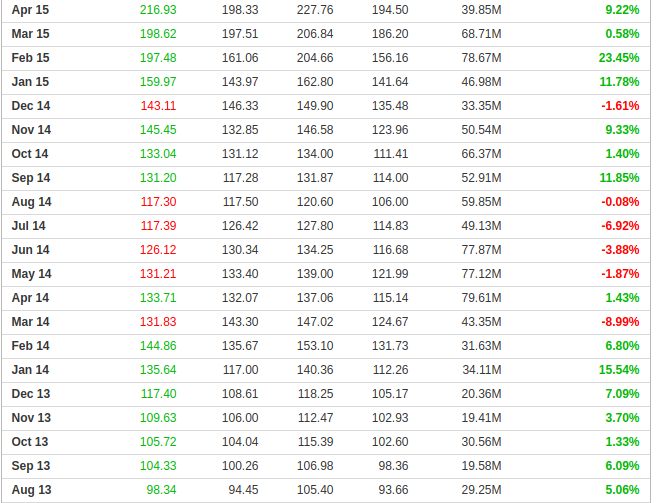
Below is a look at the Daily Journal portfolio which is essentially managed by Charlie Munger. While the Daily Journal corporation is not the primary investment vehicle for Munger, it is hard to fathom Charlie not taking his fiduciary duty very seriously at Daily Journal on managing the portfolio.

Source: Dataroma (here)

The thing that caught my eye was just how big the Wells Fargo position is. It is over one half of the portfolio at this point. It is extremely interesting because Charlie has long preached assiduity and it looks like he is practicing it hard. Not a single trade on Wells Fargo since Q4 2013 (as far back as the database at Dataroma goes).

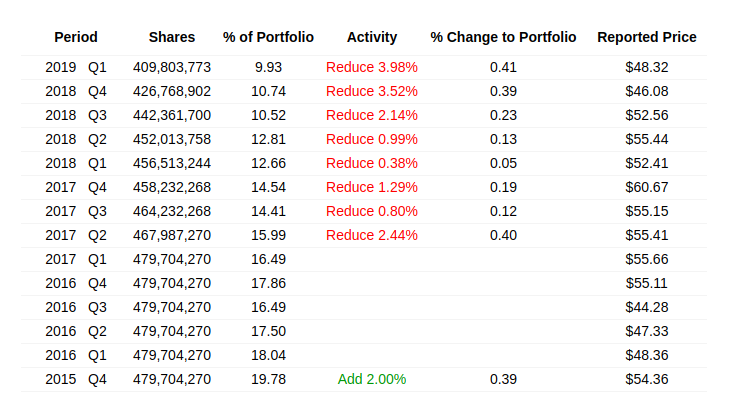
On the other hand at Berkshire, limited by an ownership limit of 10% that would force them to convert to a bank holding company, Warren Buffett has been selling just enough to keep it inside of the 10% ownership rule. While one can speculate on what would his actions if he was not loaded up to 10%, the act of keeping it just below 10% through this tough time for Wells Fargo is an indicator of the confidence that both Warren and Berkshire have on the bank.

Source: Dataroma (here)

Charlie Munger and Warren Buffett did weigh in on the Wells Fargo Issue a couple of months ago after the annual meeting at Omaha. It basically reinforces their faith in the bank while calling out the mistakes.

Some very interesting comments came from Saber Capital recently on Wells Fargo here

While it has been extremely interesting to watch the market react to the accounts scandal and politicians drum it up for headlines, what remains behind is a company that has $1.9 trillion in assets and $1.3 trillion in deposits that is buying back its shares and eating into itself. This year, an estimated 15% of the market cap of Wells Fargo will be distributed either in the form of a dividend or buybacks. Probably, it is not such a bad thing to be limited on growth but to allow the bank to buy itself back cheap on the back of negative headlines. While the headlines have been scary, the assets and the deposits are continuing to hold steady at Wells Fargo!

While time will tell how the next chapter unfolds but as an interested and a vested investor in Wells Fargo, it is tough to ignore the headlines and just watch the fundamentals. Probably time to practice some assiduity.

Blast from the Past: Timely reminder to think for yourself — Munger on Valeant

This is a dated post but fun nevertheless.

It all started in April 2015 when Valeant Pharma was the toast of town.

And then Charlie said this: “Valeant is like ITT and Harold Geneen come back to life, only the guy is worse this time.”

No one really understood what Charlie meant at that point. There were some speculations but no one was sure. This was way before the entire Valeant thing unraveled. Pause a moment to think. A lot of us had access to the same information and Munger came to a radically different conclusion than the rest of the market. Bill Ackman tried to reach out to Charlie and convince him otherwise here. Charlie turned out to be correct. How many times as investors have we had a radically different opinion than the rest of the market put together and been right? Are the markets always efficient? What qualitative factor is the market not pricing in that is not evident in the numbers?

In November in 2015, he explained himself further when Valeant started to come apart. Look at the initial response from Munger.

Later, of course, Munger ended up comparing Valeant to a sewer.

Here is how Valent played out finally. They now trade as Bausch Health Companies (BHC).

Now, Charlie also said Ackman was right on Herbalife; that has not proven out yet. Independent thinking….

Buffett on Reinsurance

Just a post to keep some notes on reinsurance to self.

The Berkshire Shareholders meeting had little in terms on new content though it was good to see that both Charlie and Warren razor sharp as ever.

Probably one of the most interesting insights came in the initial parts of the Q&A. Reinsurance. Berkshire Hathaway had sold down its position in Munich Re and Swiss Re in 2015. When asked a pointed question about it, Buffett was very articulate and gave two key reasons for it: a. Low to negative yields in Europe b. Surplus capacity in reinsurance industry.

In a way, Buffett was alluding to the fact that with hedge funds like Greenlight Re and Thirdpoint Re entering the reinsurance business and being hungry for float, it is likely that too much competition will make (or has made) pricing softer in the market. Supply up, demand is the same. This should raise two questions: a. Buffett is reducing exposure to the reinsurance business by reducing his stake, Greenlight Re and Thirdpoint Re are going long at the same time. One must thoroughly consider the consequences of betting against the man who built the most profitable reinsurance business in the world and has constantly reminded us that the insurance industry is survived the longest by those who walk away when pricing is not adequate to the risks taken. b. If there is going to be softer pricing in the market, investors in companies like Greenlight Re and Third Point re, not only have to tide over the cost of float but also the rich fees that the hedge funds rake in.  The two net cost adders might make the economics very difficult for investors to make meaningful returns unless the reinsurance companies have many home runs on the investment side.

With the low to negative yields, float becomes less valuable as the capital structure of many of the reinsurance business like Swiss Re and Munich Re allows them to invest float in only certain types of securities. Buffett is essentially betting that it will be tough for reinsurance companies to invest float in positive returns instruments for quite sometime to come. Unless of course, you are Prem Watsa and assume that deflation is going to take over in which case the bonds become very useful. Time will tell. Time to increase watch on the insurance holdings.