We have spent a lot of time reading about John Malone in the last few months and we do think he deserves a place in our portfolio. Please see our thoughts attached on Liberty Media Corporation (LMCA/B/K) here
Disclosure: Long LMCK
We have spent a lot of time reading about John Malone in the last few months and we do think he deserves a place in our portfolio. Please see our thoughts attached on Liberty Media Corporation (LMCA/B/K) here
Disclosure: Long LMCK
It has been a while since we have been active on the site. However, we have been reading quite a bit and will start posting in a short while. In the meanwhile, we have connected up Goodreads to our blog so that we can share what we are reading more easily. Too bad we cannot share the annual reports through Goodreads.
I got drawn towards Sotheby’s stock after watching a video where Jim Chanos claimed that he was short Sotheby (NYSE:BID) Jim interestingly alluded that it was a great way to bet on the economy as it catered to the 10% of the top 1% and that the stock hit $10 in every financial crisis. I decided to go through BID’s annual report to see what I could find.
Sotheby’s business can be divided into three segments: Agency, Principal and Financing.
The Agency business is where Sotheby matches buyers and sellers and cuts a premium from both at the end of the transaction. Sotheby’s sales in this segment was $825M out of the total $938M it reported for the company in 2014. It is a very high GP margin business with 88% and uses about $2.3B of assets out of which $900M+ are receivables from customers from the busy Q4 season. The main cost drivers for this segment are marketing & promotions to ensure that the right dealers and collectors are present during the collection. This has been the cash cow for the company and Sotheby’s has been seeing some serious competition from Christie’s on this. The buyer’s commission and seller’s premium that Sotheby earns in a transaction is about 14.9% on average hammer price.
Sotheby’s main rival is Christie’s and both compete furiously. It is one of the oldest duopoly in the world and is predominantly a reputation business. Sotheby’s share of the auctions done between them and Christie’s is 47%. Both have taken on different strategies off late with Sotheby catering to the ultra luxury segment and bigger ticket items and Christie’s moving lower to give a more complete collection. While other competitors like Phillips exist, the faster growing rivals are in China and HK where both the companies have expanded their horizons through acquisitions. Both operate a classic business model where reputation matters, and in which a seller is attracted to a network that will connect them to the most prospective buyers and buyers are attracted to a network where the highest potential exists for a particular interesting and authentic piece of art.
Principal: In this segment, Sotheby’s puts up capital to buy art pieces opportunistically. However, the numbers tell a very different story. The company sold about $69M of art works under this segment and made about $1.9M in the process with a gross margins of 2.7%. The period for which this capital was locked is not very clear. It is only 8% of the business and sucks about $0.1B capital and is a low return business. Given the information that Sotheby’s holds in this entire process, it is very surprising to see the low return in this business. One must also wonder why they are doing this.
Finance: Here, Sotheby finances art with a LTV of < 50%. This is an very interesting segment, as cost of capital from a credit revolver is around 2% and they are lending at close to 10% per annum. GE capital has provided this revolver for Sotheby. Sotheby has loaned about $644M with $445M in debt at 2% and rest being equity. Their NPA’s have been negligible and past dues barely any. It is one of the bright spots of the company and about 4% of the revenues are drawn from here.
At a consolidated level, Sotheby carries a debt of $2.3B of debt with $1.0B due to sellers after getting payment from buyers; $230M of mortgage for a NY properly that is adequately secured and $450M of loan from the credit revolver facilities making up the major chunk of the debt. On the asset side, this is compensated by close to $700M of cash, $900M of accounts receivable (they don’t have an obligation except where they have provided guarantees unless the buyer pays) and $698M of receivables from the financing segment.
Sotheby trades at $2.3B of market cap ($32 per share) at the time of writing. Net Income for the 2014 was $117M and $143M when you adjust for the third point activism charges that they incurred in 2014 or $2 adjusted EPS. It looks a decent franchise which will continue to play a leading role in the art world.
There are two big catches to this story:
a. Given the free monetary policies around the world, asset prices are inflated and art pieces are no exception. During the previous recessions, these companies have had really tough times moving stuff through their auction houses. Given the current state of the economy, investing in this would be a straight forward bet on the economy that it would do well.
b. The free cash flow of Sotheby has been anemic. In the last three years, it has generated about $162M of free cash flow with an average of $54M per year as compared to GAAP earnings which is closer to the $120M mark. The main culprit here in the working capital of the business, with receivables and inventory ballooning up faster than sales. It use last three years average FCF; the stock is trading north of 40 times the average FCF generated by the business.
While we do not typically short stocks, we thought it is an interesting idea to hold in the back pocket if it indeed gets any cheaper from a FCF or an owner’s earnings perspective. I must however comment that I am inclined to think favorably towards Jim Chanos’s view of Sotheby being a proxy economic indicator of the economy.
Been reading a book called ‘Extreme Ownership — How Navy Seals Lead and Win’ — Terrific book on leadership. Found a lot of lessons practical and useful as a leader (Amazon)
Was caught thumb sucking on Tata Motors stock at around INR 285 earlier this month. It was so cheap that it was a screaming buy and I understood what was going on there and had a strong opinion on it and I had been smacking my lips for it to get to that price and then I sucked thumb instead of buying…
It is already 30% higher now in a couple of weeks and no longer has the same margin of safety…. Alas!
Cost of omission!
Warning: Automobile sector definitely does not fall into our circle of competence.
On the other hand, Fiat is trading with a market cap of $19.9B and if Mr. Market is pricing Ferrari at $10.7B and is right about it and Fiat owns 80% of Ferrari, then the rest of Fiat must be ~$11B. The last ten years average profit margins of Fiat is 1.7% which would result in a normalized earnings of $1.7B (excluding $300M of Ferrari earnings) valuing Fiat at 6.5 times earnings or an earnings yield of 15%. If one wants the Fiat stub ex-Ferrari, one can go long Fiat and short Ferrari to get exposure to only the Fiat piece of the stock.
We will be watching and learning in this case and not investing / speculating as this does not fall into our circle of competence but to our limited knowledge RACE looks overvalued and since we are not familiar with the cycles of the auto industry, we have no real comment on the cheapness of the Fiat stub.
Note: We are not comfortable with the interest coverage of FIAT for the debt it holds at the consolidated level. It makes us feel that the low margins are levered returns and the underlying returns could be far worse.
I have been reading through some annual reports of a company over this weekend. Seen below is the performance of the company (blue line) compared to S&P 500 (yellow line) and DOW (orange / red line). The company has massively under performed the index and even more compared to their stronger peers.
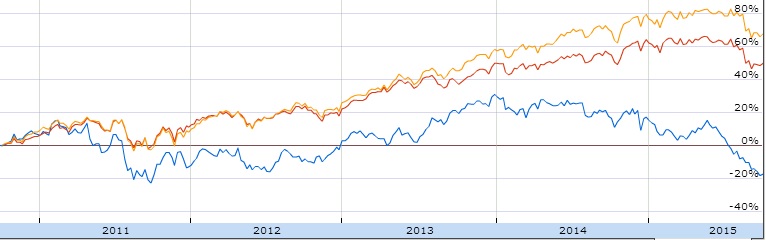
Amazingly…. the same management continues to run the show and the market is watching them do another re-org of the company. Just Wow!!!! Are shareholders asleep at the wheel?
Beer before steel (PhilisophicalEconomics)
Google should be very afraid of what Amazon has built (BusinessInsider)
Good to great companies (RJ)
Interview with Chinese president Xi Jinping (WSJ)
Be a Learning Machine (Janav)
 Beowulf Capital