What are we reading?

Simply knowing isn’t enough to change behaviors (FarnamStreet)

The evolution of a value investor (ValueWalk)

Heinz completes Kraft Merger, Buffett to Join Board (NYTimes)

Our previous post on Heinz Kraft merger and our thoughts (here)

Warren Buffett re-examines Re-Insurance (WSJ)

The education of AirBnB’s Brian Cheksey (Fortune)

How Shelby made $900M in Insurance (Valuewalk) H/T: AlphaIdeas

Be Skeptical; Mantri Developers Assures 100% Return Again with SEBI and RBI watching (capitalmind) H/T: Alphaideas

Persistent Systems: Globetrotter (Persistent)

What are we reading?

Emerson Electric to spin off the network power business (WSJ)

How Greece went Bust (Reuters)

ACE to buy Chubb for $28B (WSJ)

China’s most formidable startup is expanding outside Asia (BusinessInsider)

Fascinating facts about best selling products (BusinessInsider)

The biggest mistake investors make with options (ValueWalk)

Sysco and the hubris of buy backs

From Google finance:

Sysco Corporation (Sysco) along with its subsidiaries and divisions, is a North American distributor of food and related products primarily to the foodservice or food-away-from-home industry. The Company provides products and related services to approximately 425,000 customers, including restaurants, healthcare and educational facilities, lodging establishments and other foodservice customers. Sysco provides food and related products to the foodservice or food-away-from-home industry. The Company has aggregated its operating companies into a number of segments, of which only Broadline and SYGMA are the main segments. Broadline operating companies distribute a line of food products and a variety of non-food products to their customers. SYGMA operating companies distribute a line of food products and a variety of non-food products to chain restaurant customer locations. The Company’s other segments include its specialty produce, custom-cut meat and lodging industry products segments

Sysco was recently in the news for terminating the merger deal with US foods (link here). At the same time they announced that they would be buying back stock of about $3B from the market.

  • Total market cap of Sysco is around $22B
  • At the last close price it is trading at a PE of 25; earnings yield is 4%
  • Net margin for the business is 1.79% for TTM
  • Debt/equity for the business is at 1.44
  • ROE for the business is at 16.3% for TTM
  • FCF for the business is $868M
  • Shares outstanding for the business is 599M

Let us see what happens as a result of this buyback. For the sake of simplicity, let us assume that Sysco can buyback the stock without significantly influencing the price.

Sysco current price 37.54
Oustanding shares 599
Buyback ($M) 3000
Shares to be repurchased 79.91476
After buyback outstanding shares 519.0852
Net Income 868
EPS before buy back 1.449082
EPS after buy back 1.672172
% EPS Growth 15.4%

So far so good. Current investors can spend $3B at current prices and get a 15% bump on EPS.

Any company can spend the money it generates in four ways

  1. Dividends to shareholders
  2. Buybacks to return money to shareholders
  3. Inorganic growth through  acquisitions
  4. Fund internal programs

At any given point, the CEO, whose prime job is capital allocation, is deciding where to allocate the money.

The current ROE of Sysco is 16%. Let us explore option 4 and see what happens if Sysco is able to generate half the ROE that it generates with the new programs on which it would spend the $3B on without diluting shares by using internal cash generation and debt to generate an incremental ROE of 8%.

To be invested in additional internal project ($M) 3000
ROE 8%
Additional to FCF and Net Income / year (simplified to assume the same number for both) ($M) 240
Net Income after re-investment ($M) 1108
EPS 1.84975

The EPS growth in this case is 27% significantly higher than the buyback scenario. The ROE of internal projects needs to be 4.4% for the buyback option to make sense over the re-investment scenario which is also a possibility and we can assume that the CEO has done his due diligence.

The questions that begs to be asked are as follows:

  • What is a stock doing trading at 25 times PE when it cannot find re-investment projects at one-fourth of the ROE that the company generates today?
  • Is the management being prudent is buying back stock at 25 times earnings? Even at 20 times, the EPS growth generated will not be as lucrative as the re-investment option.
  • Is the CEO doing his job of optimal capital allocation?
  • Is the market rational and efficient when it either rewards a stock that cannot find a project at 4% ROE or is taking sub-optimal capital allocation decisions?

Not all buybacks are created equal. A conservative investor needs to be cautious before rewarding businesses blindly that buyback shares in the name of shareholder value creation.

Dun & Bradstreet (DNB) — a value trap

As per DNB’s 10-K (2014)

The Dun & Bradstreet Corporation  is the world’s leading source of commercial data, analytics and insight on businesses. Our global commercial database as of December 31, 2014 contained more than 240 million business records. We transform commercial data into valuable insight which is the foundation of our global solutions that customers rely on to make critical business decisions.

  • DNB has a market cap of $4.5B
  • Trailing PE of 18.5
  • Revenue has grown from $33.2/share in 2010 to 45.8/share in 2014
  • EPS has gone up from 4.99/share to 7.09/share
  • DNB has negative equity and ROE is infinity
  • Very strong GP margins with 66.8% which has remained flat over the last four years
  • Net margin has expanded from 15.5% in 2010 to 17% in 2014
  • LT debt to total assets has gone up from 0.5 to 0.7
  • Shares outstanding is down from 50 million shares in 2010 to 36.4 shares in 2014
  • FCF has remained flat around the $250M/year mark for the last four years

Below table shows the underlying EPS change adjusted for buybacks.

2010 2011 2012 2013 2014
Shares Outstanding 50.4 49.3 46 39.5 36.9
-2.2% -6.7% -14.1% -6.6%
Theoretical Net Income 50.4 50.4 50.4 50.4 50.4
EPS 1 1.02 1.10 1.28 1.37
Actual Net Income 252 260 296 259 294
EPS 5.0 5.3 6.4 6.6 8.0
EPS change 5.5% 22.0% 1.9% 21.5%
Underlying EPS change 3.2% 13.8% -12.5% 13.5%

The underlying business shows strong improvements in the underlying EPS except for 2013.

This is a very interesting case where so far we have seen shows a very strong underlying business. It is almost a Warren Buffett type of company.

Let’s look at the entire business from another perspective

$M 2010 2011 2012 2013 2014 4 Year CAGR
Revenue 1677 1759 1663 1665 1682 0.1%
Gross Profit 1119 1171 1142 1105 1112 -0.2%
Operating Profit 409 425 432 437 422 0.8%
Net Income 252 260 296 259 294 3.9%

So, revenue, gross profits and operating profits have not moved at all in the last four years so where is all the underlying EPS change coming from?

% 2010 2011 2012 2013 2014
Tax Rate 35.55 29.67 21.97 34.22 15.09

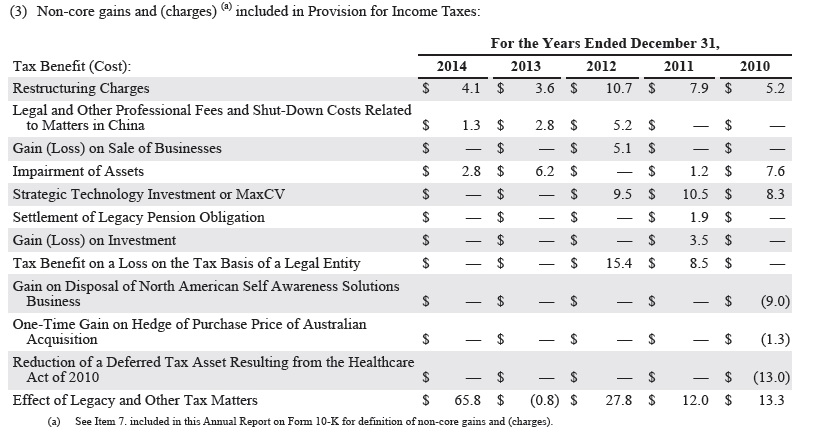
2013 EPS was -ve when DNB paid a full tax rate and 2014 EPS growth was all driven by lower tax provisions. So, what is driving this different tax rate? In page 140 of the 2014 annual report is the answer.

DNB IT

in 2013, when the company had no tax benefits from restructuring or legacy tax matters, the tax rate was full 35%. The underlying EPS change was (12.5)%. There was a $66M legacy tax in 2014 without which might not be available in 2015 and forward.  So, what was driving the $66M legacy tax benefit?

IT_2 IT_3

It definitely looks like a non-recurring tax benefit. The company does however comments that it might benefit from more sales into lower tax states but does not quantify the same. Can a conservative investor count on tax benefits to help drive free cash flow in the future?

A zero sales growth, negligible operating profit growth and free cash flow growth company is trading at 19 times earnings in the US…  With competition intensifying from low cost search aggregators and a changing landscape in technology services, Investing in DNB today does look like a very speculative bet. While the underlying business drives strong ROE and has great products, a shareholder investing in the common might not see the benefits of the same in the long run.

Disclosure: No position
Manpasand Beverages IPO

Warren Buffett’s words on IPO continue to ring true — “It’s almost a mathematical impossibility to imagine that, out of the thousands of things for sale on a given day, the most attractively priced is the one being sold by a knowledgeable seller (company insiders) to a less-knowledgeable buyer (investors).”

  • 2008-2013 soft drink market has been growing at 20% CAGR
  • The soft drink market is expected to grow at 14% CAGR between 2013 and 2018
  • Mango Sip is a single product contributing to 98% of the sales for the company
  • 17 crores of net debt versus 157 crores of net worth; net debt is pretty low
  • Return on equity for last three years has been 11.9%; 30.4% and 21.9%
  • Net profit declined from 2013 to 2014 by 10% from 22 crores to 20 crores
  • First four months of 2014, the company clocked 15 crores in net profit and 148 crores in sales (against 293 crores preceding 12 months — goosed up before IPO?); 9M 2015 sales is 239 crores and profits are 13 crores;
  • The issue size is for 400 crores, the company has outlined proposals to use up around 270 crores to building a new plant, setting up a new corporate office, drawing down corporate debt etc. and rest to be used for corporate expenses (what does that even mean?)
  • At expected market cap at 1400 crores to 1600 crores based on the IPO price; and expected 12 months trailing earnings at INR 20 crores, we are looking at a trailing PE of 70 to 80;
  • Very aggressive sales growth assumptions are built into the IPO price to justify the valuations

As Warren Buffett mentioned above, we are going to sit aside and watch this company play over the next couple of years.

Links for the weekend — what are we reading?

Hope is not an investing strategy (Safal Niveshak)

Why a few banks are really sweating heading into earnings season (Business Insider)

How to think like Sherlock Holmes (Farnam Street)

Molycorp Inc, files for Chapter 11 Bankruptcy protection (Valuewalk)

Another Ackman merger? Valent said to be in talks with Zoetis (Valuewalk)

Hugh Hendry bet big on Chinese Futures before the selloff (Valuewalk)

The value hunter — Seth Klarman searches for Value in a Sky High Market (Valuewalk)

Bed Bath and Beyond (BBBY)

  • Revenue per share is up $33/share in 2011 to $63/share in 2015
  • ROE is up from 20.85% to 28%
  • Gross Margins are down from 41% to 38%
  • EPS is up from 3.07 to 5.07
  • BBBY has been gobbling up its own shares reducing shares outstanding by 70M shares from 2011 to 2015 reducing shares outstanding from 258M to 188M
  • $6.3B shares re-purchased in last five years
  • Shares are trading at an earnings yield of 7%
  • Company does not give guidance
  • Strong cash position of $875M and net debt of $650M
  • FCF of $4.5B in last five years and $900M in last 12 months
  • Strong management team with share holder orientation

The most important question under the circumstances to ask is: what’s the catch? What can go wrong?

2010 2011 2012 2013 2014
EPS 3.07 4.06 4.56 4.79 5.07
EPS Growth 32.2% 12.3% 5.0% 5.8%
Shares Outstanding 258 244 228 213 189
% Change -5.4% -6.6% -6.6% -11.3%

If you look carefully at the above table, one can spot a potential problem. EPS growth is lower than the rate at which the shares outstanding have been declining. While it is great that the company is returning money back to the shareholders, the underlying business is losing it strength. Over the last 2 years, while shares outstanding have declined 6.6% and 11.3% and net income has risen only 5.0% and 5.8%.

To understand this better, look the below chart to see what happens to EPS when shares outstanding change.

2010 2011 2012 2013 2014
Theoretical shares outstanding 100 94.6 88.4 82.6 73.3
Net Income 100 100 100 100 100
EPS 1.00 1.06 1.13 1.21 1.37
EPS Growth 5.7% 7.0% 7.0% 12.7%

Essentially the underlying EPS growth on the base business has been trending negative for the last 24 months and essentially one is buying a negative EPS growth business goosed up by buybacks at 13 times earnings when one buys BBBY. The primary reason can be attributed to the high gross margins that the company makes at 38% in 2014 as against its chief competition online where it is significantly lower. As the online business for BBBY grows and due to competition, one can expect the underlying EPS to come further down over the next few years. While the strong cash generation and the buyback will probably put a floor on the stock and goose up EPS further, it might be worthwhile to look at it from the sidelines and participate with long term compounding machines instead unless it gets very cheap from here.

Disclosure: No position