Markel 2014 Year End Letter

Markel Corp. is arguably one of the world’s leading insurance operator. It has one of the best track records in the insurance business with a very conservative management, accounting practices and a business model that is evolving to the size the Markel is growing to. We purchased Markel on the days after the acquisition of Alterra, when for a brief few days, the shares traded at book value. Since then, we have been sitting on it.

As seen below, Markel has had a stupendous year, with both book value and the 5-year CAGR both doing pretty well. The 5 year book value CAGR is a good indicator for long term value creation for balance sheet driven companies. By and large, the letter is all good news.

Results

There is one painful section of the letter that I had a tough time comprehending — Markel Ventures. Markel has been on the tested path of Berkshire Hathaway, to own operating companies as an alternative capital allocation vehicle to investments. By and large, it has been fairly successful. Compared to ten years ago, the revenue has growth from $60M to $800+M. However, it was the discussion about EBITDA that caught my attention. Markel Ventures is measured based on adjusted EBITDA. EBITDA as a metric is bad enough but the metric goes even further and excludes goodwill impairment charges. The letter then goes through a painful section on how the goodwill impairment charges could have been avoided if the business had been lumped under a bigger business. I think since the entity was not bought as part of a bigger company, the goodwill must be evaluated at the entity level balance sheet. When one pause and thinks about it, it does not put Markel’s management in very good light. It will very important to keep track of Markel Ventures as it becomes a bigger piece of Markel. More disclosure in Markel ventures would be a welcome change in the future.

EBITDA

Impairment1

Beyond that, the letter provided a good insight into the state of affairs at Markel. With Alterra being more conservatively reserved than before, the integration happening well, the insurance business performing robustly and the investment business roaring, Markel’s management no doubt deserves the trust of shareholders. The record that they have generated speaks volumes for the way the management runs the business. This is one no brainer compounding machine over the long run if bought at the right prices. At March 20th closing price of $778.5 and book value of 1.4, good performance is fairly baked in the price. It is no longer the bargain it was post the Alterra acquisition but definitely one worth holding in the books if one already has it.

Disclosure: Own shares of Markel.

Thomas Cook and Fairfax

Prem Watsa, Chairman and CEO of Fairfax Financials, has compounded book value at 21.2% and stock price at 19% since 1985. There was a great deal of excitement when Fairfax took over the Thomas Cook operations in India. All investors, value, momentum and traders piled up on the stock. The best analysis post the acquisition was provided by renowned value investor, Sanjay Bakshi on Thomas Cook as an investment vehicle for Fairfax in India. See here

Fast forward, a couple of years and below is what appeared on the annual report of Fairfax Financials in March.

Fairfax

It raises the following questions

  • Looks like Thomas Cook will also be a acquisition vehicle but all big ticket items would go through this new entity.
  • Given the fees that Fairfax would gain from the transactions through the new entity, it seems it is logical that the best of ideas might flow through the new entity.
  • Why could Fairfax just not recapitalize Thomas Cook to be owned through an entity in Canada and issue more stock at the current price?
  • Will there be any conflict of interest every time Fairfax uses the allocation vehicle instead of Thomas Cook to Thomas cook shareholders? Will Thomas Cook shareholders be shortchanged in the long run?

I have always been a big fan of Prem Watsa but it looks like the current move is more beneficial to Fairfax owners than to Thomas Cook.

Disclosure: Own shares of both Fairfax and Thomas Cook India

Biglari Holdings and Groveland Capital

A very interesting fight seems to be brewing between two activist investors, the brash young CEO Sardar Biglari of Biglari Holdings and Groveland Capital. A tiny hedge fund with a 1% position in Biglari Holdings is trying to nominate its own board. Sardar Biglari, one not be backed down, published the following presentation in response to Groveland’s nominations and presentation here.

The main thrusts of Groveland objections are under performance against the S&P 500 and excessive CEO compensation.

From the first snapshot below, from a 1-year, 3-year and 5-year perspective, it does look like Biglari Holdings has under performed the S&P 500. In the long run, the stock price is the true indicator of value creation. Looks like Groveland does have some merit in their 5  year argument. We will look at Biglari Holdings 6 year test later.

BG1

BG2

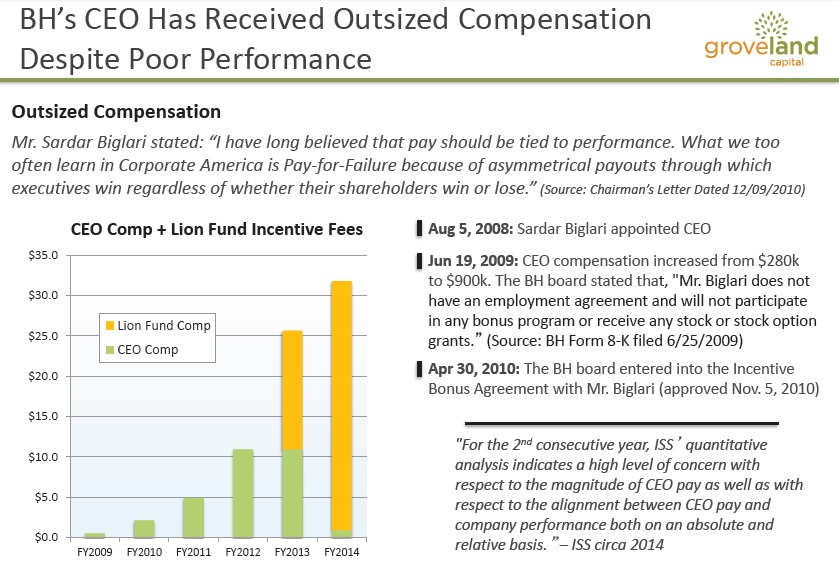
The compensation for Biglari holdings has increased quite a bit with the Lion fund compensation that he has been getting over the last few years. So, it is indeed true that fees do look high with respect to the under performance versus the S&P 500. We will dive into the actual performance of the Lion Fund later.

BG5

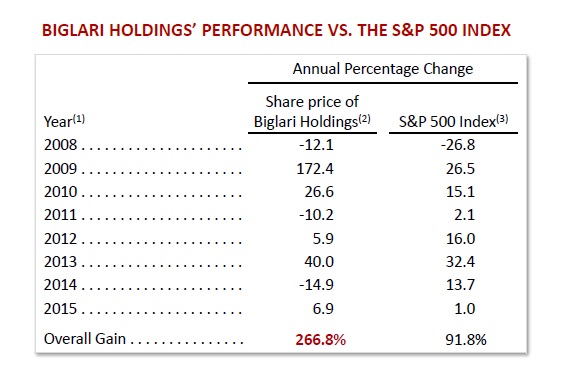
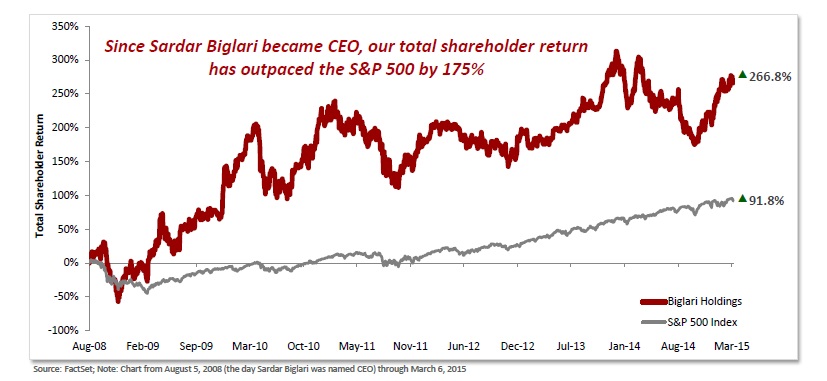
Biglari shot back with his own presentation in which he included the 2009 results to the mix. As all of us know, 2009 was when the markets started rising like a phoenix from the ashes. When we include the results of 2009, it paints a very different picture of the performance of Sardar Biglari against the S&P 500.

BG4

BG3

The question is it fair to include the 2009 results? Is 5 years a sufficient time frame to do reasonably well as against the market? Granted that Biglari Holdings had one great year in 2009 but since then the stock has not performed so well. When we look at the underlying business, there has been two rights offering as well where the shares have been diluted from a shareholder perspective.

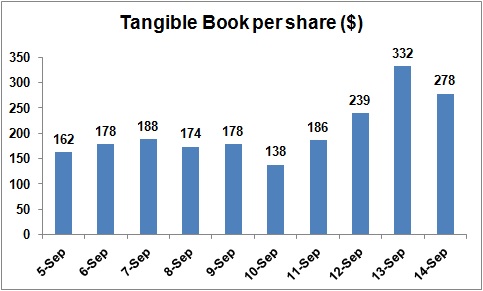
Given the disparate nature of the businesses owned by BH and dilution, perhaps growth in tangible book value per share is a better indication of the value creation at BH as against just the operating earnings. The one, two, three and five year CAGR’s are -16.3%, 7.9%, 14.2% and 9.3%. So, compared to the S&P 500 5 year CAGR of of 13.2%, it does look like the value creation has been sub par as against the market. It must be noted that even Warren Buffet has under performed during the last few years but on a company that is several hundred times bigger than BH.

BH6

To justify the performance fee that Sardar Biglari has been drawing through the Lion’s fund, BH put up the following performance to justify the performance. The below chart shows outperformance every year as compared to the S&P500 but it has not resulted in book value per share gain for share holders even with the investment portfolio marked to market in the balance sheet.

BG7

While it is not clear how groveland capital can add any more value to this situation, it is also pretty clear that BH has not been creating tangible book value per share growth in meaningful way for shareholders to consider investment over the market. With a ego-driven CEO, untimely rights offerings, over the top compensation, the cautious investor’s best position would be in the grand stands watching the fight rather than participate in what will be a colorful match of activist investors.