Talking one’s book

There are two schools of thought among value investors who choose to talk or not to talk about the current portfolio that they hold.

Theory A: Don’t talk about the book

  • Talking about the investments in the portfolio forms a stronger bias in the investor’s mind. Also reversing the position becomes tougher as it contradicts the public position taken on the stock.
  • Public starts forming opinions on the investors based on the performance of the stock that the investor is talking about. It is similar to hedge fund managers facing pressure from the public on short term performance.
  • Ideas are considered as proprietary material. No good reason to share them with the public. It is the product of the firm and it must protect it.
  • When you recommend a stock and change your position, you might not have the time to clarify on the changed thinking and might be selling while others might be buying based on your earlier position. But few investors have the ability to sway the market’s opinion based on their stock ideas

Theory B: Talk about the book

  • It actually makes you a better investor as it crowd sources  opinion into your thought process and you are not under any obligation to be influenced by the thought process of others. Might also bring into consideration perspectives not considered by you in the original thought process.
  • If you are in a position to influence the general market’s opinion based on your thought, it becomes a self fulfilling prophecy. I am not saying going ra-ra and marketing the stock; I am talking about showing the market the catalyst for undervaluation and add to the market’s knowledge on why they need to change their opinion collectively on the stock (Easier said than done)
  • Biggest advantage in my opinion is, if you are confident about your thesis and you are a value investor who can stand out in the crowd, one must not be afraid to talk about one’s book with the right disclaimers. All perspectives can be filtered appropriately and can only enhance one as an investor.

There are investors who believe in both sides of the theories but the important thing is to be consistent about it. In between the two, there are a swathe of investors who talk about stocks at their convenience. I have seen investors who talk about only the stocks that might have gone up multi-fold in their portfolio with hardly any mention about the ones that have not. The public then bids up the securities even more making them even more successful. There are a couple of managers that I track who have disclosed ideas that have only gone up over the years and make it sound that they have never have lost money which is highly questionable as well.
Good companies and exhorbitant valuations

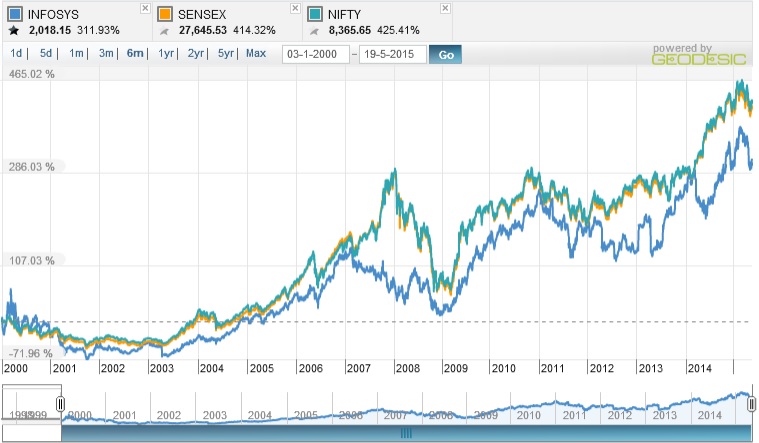
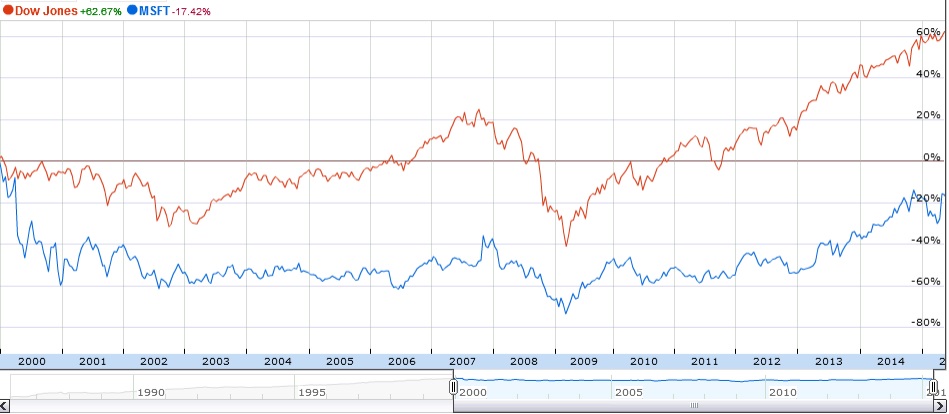
We will take a quick look at two companies (INFY) and (MSFT) that was trading at close to 310 historical PE and 58 respectively in 2000. This was at the height of the bubble. Something common in addition to being IT companies, both companies boasted of good managements, great business model and a long runway in front of them. The market was pricing the heaven on earth into their price. How did they turn out over the next 15 years?

Infy:

Infy

Infy sales on 2000 was 9210 million INR and net profits was 2930 million INR. In 2014, sales was ~530000 million INR and profits were ~100000 million INR. The sales multiplied 50X and profits went up 40X.

MSFT

MSFT

MSFT revenue went up from $23B to $95B and net profits went up from $9B to almost $22B. The stocks is down -17% over the same time while the Dow Jones in comparison went up 60%. While the performance of the company was great, to justify the valuations the company had to grow 5-6X on net profit line instead of the 1.5X that they did during the same time frame.

If you look at the companies above, the PE’s were high and despite a 50X improvement from INFY and 1.5X improvement from MSFT, they were not able to beat the market. In today’s context, when you see PE’s of some Indian companies, like Page industries at 89 PE, Symphony at 61 PE, Nestle at 54 PE, Glaxo Smith Consumer at 46X, Emami at 52X…. while they might have good managements and great business models, and over a long period of time you will not risk permanent loss of capital, beating the market might not be as easy as it looks. The odds are already stacked against the average investor who is buying at these PE’s.

The thing that makes the art of stock picking interesting is the fact that it is always possible to identify great companies with good moat but they are usually bid up in price handicapping it against you. The key to success is to handicap it by not overpaying for these companies and wait patiently for the companies to come to you at reasonable valuations.

Buffett Partnership — in Today’s context

The initial piece below in italics is adopted from buffettfaq.com

According to a business week report published in 1999, you were quoted as saying “it’s a huge structural advantage not to have a lot of money. I think I could make you 50% a year on $1 million. No, I know I could. I guarantee that.” First, would you say the same thing today? Second, since that statement infers that you would invest in smaller companies, other than investing in small-caps, what else would you do differently?

Yes, I would still say the same thing today. In fact, we are still earning those types of returns on some of our smaller investments. The best decade was the 1950s; I was earning 50% plus returns with small amounts of capital. I could do the same thing today with smaller amounts. It would perhaps even be easier to make that much money in today’s environment because information is easier to access.

You have to turn over a lot of rocks to find those little anomalies. You have to find the companies that are off the map – way off the map. You may find local companies that have nothing wrong with them at all. A company that I found, Western Insurance Securities, was trading for $3/share when it was earning $20/share!! I tried to buy up as much of it as possible. No one will tell you about these businesses. You have to find them.

Other examples: Genesee Valley Gas, public utility trading at a P/E of 2, GEICO, Union Street Railway of New Bedford selling at $30 when $100/share is sitting in cash, high yield position in 2002. No one will tell you about these ideas, you have to find them.

The answer is still yes today that you can still earn extraordinary returns on smaller amounts of capital. For example, I wouldn’t have had to buy issue after issue of different high yield bonds. Having a lot of money to invest forced Berkshire to buy those that were less attractive. With less capital, I could have put all my money into the most attractive issues and really creamed it.

I know more about business and investing today, but my returns have continued to decline since the 50’s. Money gets to be an anchor on performance. At Berkshire’s size, there would be no more than 200 common stocks in the world that we could invest in if we were running a mutual fund or some other kind of investment business.

If you are an investor in a market like India today, would this is applicable to you? What would be the things that would work for you and things that would hinder you…

  • Value investing works everywhere globally however it is the margin of safety that varies across the different region
  • In a country like India, where investor protection is very low, value traps and dubious management are the norm of the day, the statistical bargains  become a whole lot more riskier with the probability of permanent loss of capital increasing
  • The statistical bargains that Buffett talks about relies on two sources of safety — cheapness and concentration like he did in his partnerships. Even with these, it looks tough to create alpha without good investor protection. When one studies the Buffett partnership model carefully, Buffett created alpha through workouts and generals and in some cases, the generals that got  converted into workout e.g. Sanborn maps, Dempster and to some extent Berskhire Hathaway (though history ensured that Berkshire had a different fate) Without the strong investor protection, it is doubtful whether similar situations can be worked out in India
  • Other sources of Margin of Safety like quality, moats, superior business models, management with the backwind of a market like India where alpha has been created over a long period of time might have better probabilities of success. If one were patient and did not worry much about volatility and could handle concentration, the odds of success in the market magnifies several points over. It might be possible to replicate the sort of success Buffett had in India though with different sources of value than he did in the 50’s but it definitely won’t be a walk in the park like Buffett makes it sound.

Daniel Loeb’s hedge fund and the original Warren Buffett hedge fund structure

Recently, Third Point’s Daniel Loeb launched a scathing attack on the Oracle of Omaha and his hedge fund structure. “I love how he criticizes hedge funds, yet he really had the first hedge fund. He criticizes activist investors, yet he was the first activist,” says Loeb.

It was must be recalled that Warren Buffett ran one of the original uber-successful hedge funds in the industry. Today, hedge funds are dime a dozen in the US. A closer look at the original ‘hedge-fund’ partnership of Buffett reveals the following:

  • The ‘Buffett Associates’ structure was a partnership. Not a limited liability partnership, just a plain partnership which meant that Warren was exposed to unlimited loses. His obligation to pay back was not limited to his capital. I think this was a very gutsy move. The confidence that Buffett shows on his own abilities is amazing. This does align his incentives with that of his partners.
  • No management fee.
  • To boot that, he also paid 4% interest on the capital. If the performance exceeded the 4% hurdle, Buffett got paid 25% of the profits. Now, consider this. If the partnership just broke even, Buffett had make good the difference to the tune of 4%. With liabilities not limited to his capital, on a base of $105K capital that Buffett raised, he had invested only $100. His potential losses would have been high. However, Buffett did have other money that he had accumulated. In a bad year, if the partnership was down 40% (say), Buffett would have to pay 4% and the partnership would lose 36%.
  • in 1958, Buffett amended the partnership further in favour of his partners, where he agreed to take 25% of all downsides. Which mean, if the partnership was down 40%, Buffett would pay 4% interest and 10% of the losses from his own capital. Buffett’s hedge fund structure was onerously favouring the shareholders in bad years and limiting their downside while leaving them with a sizable upside as well.

Compared this to Third Point’s 2 and 20 structure is in stark contrast where Loeb’s stands to make money of 2% even if the partners lose money with very limited liability. It is a classic screw the clients in a bad year and scoop their profits in good years. I think the difference between the two structures are night and day, a far cry from the shareholder orientation that Warren Buffett had in his partnership.

Kraft – Heinz and the Buffett Return

We looked carefully at the Kraft and Heinz merger deal and we were blown away by the numbers. Let us look at it two separate ways to see whether it holds water:

Berkshire and 3G bought Heinz by investing $4.25B of equity each and Buffett topped it with $8B of preferred stock in Heinz. Berkshire has already received $1,440M of dividends from the preferred stock in two years. Chances are by the time the stock gets called, he would have received another $720M of the dividends.

Berkshire and 3G are adding $5B each to pay the $10B dividend @ $16.5/share. At today’s closing price of $88.95/share, ex-dividend, the share is worth $72.45/share. Buffett on CNBC said that post the $5B investment, he would own 320 million shares of the combined company. That is worth $28.3B. $5B of that is yet to be invested, so, $4.25B turned into $23.45B in 2 years. This is a mind-boggling return of 450% in 2 years. What an elephant he has bagged on such a big investment…..

To top it all, Berkshire will also get $8B back next year that he has to deploy elsewhere from the calling of the preferred stock. In addition, 3G has indicated that they will maintain the current 3% dividend, that is $2.2/share dividend on 320 million shares, about $700M/year will flow into Omaha starting this year.

The other way to calculate it is, Kraft’s market cap today is $52B; Kraft’s shareholders will get $10B dividends; 49% of the combined company that Kraft’s current shareholders will own, will be worth $42B; 51% of the rest will be worth $43B; initial equity investment was $8.5B equally by 3G and Berkshire; Implied value for the original $8.5B is $43B; (not taken into account the $10B dividend as it will flow from Berkshire and 3G in the future to Kraft’s shareholders)

Either way, Warren Buffett’s elephant gun has fired a salvo that will bring cheers to his shareholders as a new equity position that will be his largest or second largest position once the transaction is closed depending on the stock price on any given day.

What are we thinking?

We are thinking quietly about the Kraft Heinz deal. What is the hidden margin of safety that Buffett is counting on?

When we look back on Berkshire’s acquisition of BNSF, the deal initially looked crazy. Here is Warren’s justification for it and here is what some of the value investors thought about it. Investors believed that Warren had gone loco. The deal turned out to be very good for Berkshire shareholders. Five years since the deal, BNSF has provided $15B dividends back to Berkshire on the purchase price of $26.5B that he paid to own the rest of the company. (Link) Part of that was luck due to oil being transported more on rails compared to five years ago that even Warren could not have anticipated. Nevertheless, when Warren has capital of tens of billions of dollars that needs to get allocated, he is still finding deals with the required margin of safety and returns proving that he is a continuous and an innovative learner. If one were to value the railroad at where the competitors are trading it, it looks like BNSF will be worth about $66B.

One has to sit back and think about what are the margins of safety is Warren counting on the Kraft-Heinz deal? One, of course is 3G’s focus on cost. But is there something beyond it? What does it mean for the Shareholders? It will be the second biggest security in the Berkshire’s portfolio soon.

The contrarian insurance play — Fairfax Financials 2014 Letter

Fairfax Financials, run by the contrarian CEO, Prem Watsa, continues to be bearish on the prospects for the world economy and Fairfax is backing his conviction with a very big bet on CPI linked contracts. While the world continues to be riveted on the statements of the Fed and is expecting a rate hike in the near future, Fairfax bets seem to question the sustainability of the hikes. Recent comments from Bridgewater chief, Ray Dalio, seems to the only other prominent voice echoing similar sentiments.

Fairfax had a good 2014, as is the case with most insurers, primarily driven by lack of catastrophes. Book value increased 16% to $395.  Combined ratio was 90.8% and the company ended with $11.7B of float. Unrealized gains from bonds held in the investment portfolio contributed $1.1B of gains and drove the net earnings number higher in 2014. A closer look at the performance of the investment portfolio shows a mixed picture. The equity hedges has cost the company a pretty penny and almost all of the gains have come from the bonds portfolio.

Performance

Fairfax’s bet on bonds has spectacularly paid off while its equities have severely underperformed the market primarily driven by hedging. Prem Watsa and his team seem to be very confident about the market unravelling due to the grand disconnect between fundamentals and stock prices. It is worth noting that ten years ago, Prem Watsa had placed a similar bet on the housing market and suffered through initial years of losses before spectacularly reversing the losses during 2007 and 2008 as seen below. Only time can tell whether Fairfax will gain spectacularly on these CPI linked hedges.

20032006

If one digs a little deeper into this, the cost of these contracts seem to be only 7% of equity. On the surface, it looks like a bet where the payoff is huge with minimal downside risk. Currently, they have a string of loses to show for the bet between the CPI linked contracts and the equity hedges. Cumulatively, it has cost Fairfax Shareholders close to $4B to keep this bet on.

Hedges

Furthermore, Fairfax is increasing the size of the CPI linked bet on deflation. The notional amount is now $111B. CPI seems close to the strike price and for the first time, the bets looks like having any chance of making money for shareholders.

CPI1

So far so good. However, if inflation does occur like the rest of the investment community believes in, Fairfax stands to suffer from a triple whammy. Firstly, the loss from the CPI indexed contract. Secondly, the gain on equity will be minimal due to the hedges involved if the market does not unravel. Thirdly and most importantly, the bond portfolio might come under attack. Fairfax would still retain the option on holding the bonds to maturity and redeeming them but will have to announce mark to market losses in the meantime.

In net, Fairfax seems to be riding the wave of good underwriting profit along with most of the good insurers. The future seems to be hinged on the great disconnect in the stock markets. Only time will tell whether there the grand strategy will pay off or will it result in a lost decade for the insurer.

Disclosure: Long Fairfax
